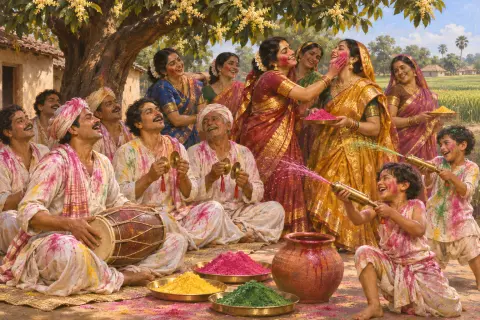
Narasimha, the man-lion, is the fourth avatar of Vishnu in the common list of ten. He has a man's body and a lion's head and claws. He burst out of a pillar to save the boy Prahlada from his father Hiranyakashipu, an asura king who had won a boon that seemed to make him impossible to kill. The fullest telling is in the Bhagavata Purana, Book 7, and the story is remembered at Holi and on Narasimha Jayanti. He is worshipped as a fierce protector and, with Lakshmi on his lap, as a gentle one, at great temples such as Ahobilam and Simhachalam in Andhra Pradesh.
Also called: Narasimha or Nrisimha (man-lion), Narahari (Hari as man), Nrisimhadeva, Ugra Narasimha (the fierce one), Lakshmi Narasimha (with Lakshmi), Yoga Narasimha (seated in meditation), Prahlada Varada (who gave boons to Prahlada), Simhachala Nivasa (who lives on Simhachalam), Panakala Narasimha (at Mangalagiri, offered jaggery water)
Who he is: an avatar of Vishnu, the fourth in Jayadeva's list of ten
Consort: Lakshmi, as Lakshmi Narasimha; in Ahobilam's local tradition also Chenchu Lakshmi, a girl of the Chenchu forest people
Devotee: Prahlada, son of Hiranyakashipu
Foe: Hiranyakashipu, king of the daityas, brother of Hiranyaksha whom Vishnu killed as Varaha
Appearance: at twilight, from a pillar in Hiranyakashipu's hall; Narasimha Jayanti is kept on the fourteenth day of the bright half of Vaishakha
Famous shrines: Ahobilam and Simhachalam in Andhra Pradesh, Yadagirigutta in Telangana, Mangalagiri, Melukote in Karnataka
sa sattvam enaṃ parito vipaśyan
stambhasya madhyād anunirjihānam,
nāyaṃ mṛgo nāpi naro vicitram
aho kim etan nṛ-mṛgendra-rūpam.
Looking all around, he saw this being coming out from the middle of the pillar. "It is not a beast, and it is not a man. How strange! What is this form, a man and the king of beasts at once?"
Stories
Narasimha is one of the older avatar stories. The Taittiriya Aranyaka (10.1) already has a Narasimha gayatri to the god with diamond claws and sharp teeth, and the avatar lists of the Mahabharata and the Harivamsha include him. The Vishnu Purana (Book 1) dwells on Prahlada's trials and mentions the man-lion only briefly. The fullest and best-loved telling is in the Bhagavata Purana, Book 7, chapters 1 to 10, which the stories below follow; the Matsya Purana and the Narasimha Purana have their own versions. Shaiva texts add a later sequel in which Shiva calms him. Temple traditions, especially in Andhra Pradesh, place the events in their own hills.
The Doorkeepers and the Boon
The Bhagavata (7.1) begins far away, in Vaikuntha. Jaya and Vijaya, Vishnu's doorkeepers, stopped the four child sages, the Kumaras, from entering, and were cursed to be born three times as Vishnu's enemies. Their first birth was as the brothers Hiranyaksha and Hiranyakashipu, sons of Diti.
When Vishnu as Varaha killed Hiranyaksha, Hiranyakashipu swore revenge. He went to the valley of Mandara and stood in penance so long that ants built a hill over his body and ate his flesh. Brahma came, sprinkled water from his pot, and the asura rose up young and strong (7.3).
Hiranyakashipu asked for a boon that left almost nothing out. Let me not die by any being you have made, he said, not inside or outside, not by day or by night, not on the ground or in the sky, not by any weapon, not by man or beast, god or demon or great serpent. Brahma granted it. Hiranyakashipu then conquered the three worlds and forbade the worship of Vishnu.
The Boy Who Would Not Stop
Hiranyakashipu's son Prahlada had heard of Vishnu while still in his mother's womb, from the sage Narada. At school, when his teachers asked what he had learned, he said the best thing was to hear about Vishnu, sing of him and remember him (7.5). His father was furious.
He tried to kill the boy again and again: with weapons, with elephants and snakes, with poison, by throwing him from a height, by fire. Each time Prahlada was unharmed. The Prahlada page tells these trials in full.
At last the king called the boy before him in his great hall. Where is your Vishnu, he asked, if he is everywhere? He is everywhere, said Prahlada. Then is he in this pillar? The king struck the pillar with his fist.
Out of the Pillar
On the threshold at twilight, Narasimha keeps every word of Brahma's boon.
A terrible roar came from the pillar, so loud that the gods in their worlds thought the universe was ending. Hiranyakashipu looked around for the source of the sound and saw a being coming out of the pillar, neither beast nor man (7.8.18, the verse at the top of this page). The Bhagavata says he came to prove true the words of his devotee, that God was everywhere, even in a pillar.
The king fought him with his mace. For a while Narasimha let him struggle, the way Garuda plays with a snake. Then, at twilight, neither day nor night, he seized him and carried him to the threshold of the hall, neither inside nor outside. He laid him across his thighs, neither on the ground nor in the sky, and tore him open with his claws, which are not weapons. He was neither man nor beast, and no being Brahma had made (7.8).
Every condition of the boon was kept, and it did not save the king. The gods, sages and celestial singers came and praised Narasimha one after another, from a distance.
The Anger That Would Not Cool
Narasimha's fury did not settle. He sat on the king's throne, his mane shaking. Brahma, Shiva and the gods were afraid to go near him. They sent Lakshmi, and even she, the Bhagavata says, had never seen such a form and was afraid to approach (7.9.1 and 2).
So Brahma sent the boy. Prahlada walked up and lay down at his feet. Narasimha lifted him up and put his hand on the boy's head, and his anger melted. Prahlada then sang the long prayer of chapter 9, in which he asks nothing for himself and prays for all beings, even the cruel. Narasimha offered him boons; Prahlada asked only that his father be purified, and was told that twenty-one generations of his family were already freed (7.10).
Shaiva texts tell a different ending. In the Shiva Purana (Shatarudra Samhita) and the Linga Purana, when Narasimha's rage threatens the world, Shiva takes the form of Sharabha, a great winged beast, and subdues him. Vaishnava tradition does not accept this story, and it is told mainly in Shaiva temples.
Ahobilam, Simhachalam and Narasimha Jayanti
Temple tradition at Ahobilam, in the Nallamala hills of Andhra Pradesh, holds that this is where Narasimha came out of the pillar and killed Hiranyakashipu. Pilgrims climb to a split rock called the Ugra Stambha, which they believe is the pillar, and visit nine shrines of Narasimha in nine forms spread over the hills. Local tradition also says that here he fell in love with and married Chenchu Lakshmi, a girl of the Chenchu tribe, and the Chenchus still take part in the festivals.
At Simhachalam near Visakhapatnam, the god is worshipped as Varaha Lakshmi Narasimha, joining the boar and man-lion avatars. The temple's own story says Prahlada built the first shrine here after he was saved. The image stays covered in sandalwood paste through the year, and on Akshaya Tritiya, at the festival of Chandanotsavam, the paste is removed and huge crowds come for the single day's sight of his true form.
Narasimha Jayanti falls on the fourteenth day of the bright half of Vaishakha. Devotees fast and worship him at dusk, the hour he came out of the pillar. Many keep a simple prayer to him for protection, especially for children, because he came running for a child who called him.
How to recognise
•A man's body with a lion's head, a thick mane and sharp claws. The Bhagavata (7.8) describes eyes like molten gold, a mane that shone, fearsome teeth and a tongue as sharp as a razor.
•Usually four arms, with Vishnu's discus and conch in the upper hands. In fierce images (Ugra Narasimha) the lower hands tear open Hiranyakashipu, who lies across his thighs; some images have eight or more arms.
•Lakshmi Narasimha: calm, seated, with Lakshmi on his left knee and his arm around her. This is the form most homes keep. The huge monolith at Hampi, carved in 1528 under Krishnadevaraya, showed Lakshmi on his lap before the image was damaged.
•Yoga Narasimha: seated cross-legged with a band (yogapatta) around his knees and his front hands resting on them, in meditation. Many hill shrines show him this way.
•Prahlada often stands or kneels at his feet with folded hands, and the broken pillar may stand beside him.
•At Simhachalam the image is covered in a thick layer of sandalwood paste all year, so that it looks like a smooth mound. Only on Akshaya Tritiya is the paste removed for the nija rupa darshan, the sight of his true form.
For the protection of the good, for the destruction of the wicked and for the establishment of righteousness, I am born in every age.
To protect the good, to end the wicked and to set dharma in place, Krishna says, I come into being age after age. The verse does not name Narasimha, but his rescue of Prahlada is one of the clearest examples of what it describes.