Vasishtha is one of the oldest and most honoured Vedic sages, the seer to whom the seventh book of the Rigveda is attributed, and one of the seven great sages (saptarshi). In the Ramayana he is the family priest and teacher of the kings of Ayodhya: he guides Dasharatha, teaches Rama and crowns him at the end. His wish-granting cow, called Shabala in the Ramayana and Nandini in the Mahabharata, started his long rivalry with Vishvamitra, which ended in friendship. His wife Arundhati is remembered as a model of faithfulness, and his great-grandson is Vyasa. The Yoga Vasishtha, a much later philosophical work, is presented as his teaching to the young Rama.
Also called: Maitravaruni (son of Mitra and Varuna), Brahmarshi Vasishtha, Brahmaputra (son of Brahma, in the epics and Puranas), Kulaguru of the Ikshvakus, Arundhatipati (husband of Arundhati)
Birth: son of Mitra and Varuna, born when they saw the apsara Urvashi (Rigveda 7.33); the epics and Puranas also call him a mind-born son of Brahma
Brother: Agastya, born with him from the same pot in the Rigveda's account (7.33.13)
Wife: Arundhati, honoured in the epics and Puranas as a model of a faithful wife
Sons: Shakti (Shaktri) and many others; the Mahabharata says Vishvamitra's anger had a hundred of them killed
Grandson and great-grandson: Parashara, son of Shakti, and Vyasa, son of Parashara
Pupils: the kings of the Ikshvaku line, among them Dasharatha and Rama; in the Mahabharata Bhishma learns the Vedas from him
You are also the son of Mitra and Varuna, Vasishtha, born, O priest, from the mind of Urvashi. The drop that fell, by a divine prayer, all the gods placed in a lotus: that was you.
Stories
Vasishtha is first a poet. The seventh book of the Rigveda is attributed to him and his family, the Vasishthas, and its hymns show him as the priest of King Sudas of the Tritsu-Bharatas and as a man who speaks to the god Varuna as to a friend. In the Ramayana and Mahabharata he becomes the great royal priest, steady and forgiving, set against the proud Vishvamitra. The Mahabharata adds the grief of losing his son Shakti and the birth of his grandson Parashara. Much later the Yoga Vasishtha, a long work of Advaita philosophy, takes his name and makes him the teacher of the young Rama.
Born of Mitra and Varuna
Rigveda 7.33 tells Vasishtha's birth in the words of his own family. Mitra and Varuna, two of the oldest gods of order and truth, saw the apsara Urvashi, and their seed fell into a jar. From it rose Mana, that is Agastya, and from it, the hymn says, the sage Vasishtha was born (7.33.13); another verse says the gods placed him in a lotus (7.33.11). So the two great sages are brothers, and both are called Maitravaruni.
The same hymn tells why the family was honoured. When King Sudas fought the Battle of the Ten Kings (7.18 and 7.33), the Vasishthas prayed and Indra heard them, and the small Tritsu people won.
His hymns to Varuna are among the most personal in the Rigveda. In 7.86 he asks: "What was my great wrong, Varuna, that you want to destroy your singer and your friend?" He asks to be freed from the sins of his fathers and from his own. In 7.88 he remembers sailing with Varuna on the sea in a boat, and asks why that old friendship has gone.
The Cow and the Staff
Vishvamitra's soldiers try to take Vasishtha's cow.
In the Ramayana (Bala Kanda, sargas 51 to 56), King Vishvamitra comes to Vasishtha's hermitage with his army. Vasishtha feeds them all from his wish-granting cow Shabala, and the king asks for her. Vasishtha refuses, gently and firmly: she is all he has. When the king's men drag her off, she runs back to him and asks why he has given her up. He answers that he has not; he is only a brahmin and cannot fight a king. She asks for his leave, and from her body come armies that rout Vishvamitra's soldiers.
Vishvamitra comes back with divine weapons won from Shiva. Vasishtha stands in front of his burning hermitage holding only his wooden staff, and it swallows every weapon, one after another, until even the Brahma weapon goes into it. The Mahabharata (Adi Parva, Chaitraratha section) tells the same story with the cow called Nandini, and has Vasishtha say: "A kshatriya's strength is in his body; a brahmin's strength is forgiveness."
The same cow appears again in the Mahabharata. The eight Vasus stole Nandini from Vasishtha's hermitage, and he cursed them to be born as men. Seven of them were freed at birth; the eighth, Dyu, lived a long human life as Bhishma. The Bhishma page tells that story.
Grief, and the Rivers That Would Not Drown Him
The Mahabharata (Adi Parva, sections 178 to 180 in Ganguli's translation) tells the hardest part of Vasishtha's life. King Kalmashapada of the Ikshvaku line, cursed by Vasishtha's son Shakti and pushed on by Vishvamitra's ill will, became a man-eating rakshasa and devoured Shakti and all of Vasishtha's other sons.
Vasishtha, who had forgiven everything, could not bear this. He threw himself from the peak of Meru, and landed on the rocks as if on a heap of cotton. He lit a great fire in the forest and walked into it, and it did not burn him. He tied himself with cords and leapt into a flooded river, and the river cut the cords and set him on the bank; he named it Vipasha, the unbinder (the Beas). He threw himself into another river, and it fled from him in a hundred streams, thinking him a fire; it became the Shatadru, the hundred-coursed (the Sutlej).
Turning home, he heard someone behind him reciting the Vedas perfectly in Shakti's voice. It was his daughter-in-law Adrishyanti; the voice was the child in her womb, who had been learning the Veda for twelve years. Vasishtha gave up the wish to die. The child was Parashara, father of Vyasa. Later Vasishtha met Kalmashapada, sprinkled him with water and freed him from the curse.
Guru of Ayodhya
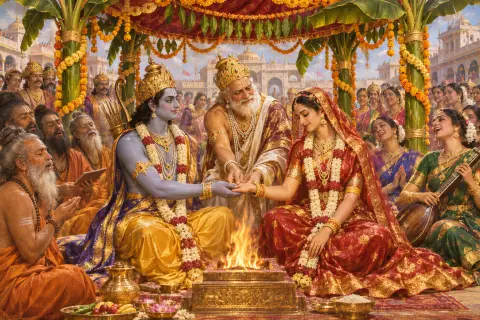
In the Ramayana Vasishtha is the priest and adviser of the Ikshvaku kings. When Vishvamitra asks for the young Rama and Dasharatha refuses, it is Vasishtha who reminds the king that he gave his word and tells him that Rama will be safe (Bala Kanda 21). At Rama's wedding in Mithila he recites the line of Ayodhya's kings from Brahma down to Dasharatha (Bala Kanda 70).
When Dasharatha dies of grief, Vasishtha sends fast messengers to bring Bharata home, telling them to say nothing of what has happened (Ayodhya Kanda 68). After the war, he and the other sages crown Rama in Ayodhya, and the Yuddha Kanda (sarga 128) says that Vasishtha set the crown on his head.
Earlier in the same line, the Bala Kanda (sargas 57 and 58) has him refuse King Trishanku's wish to go to heaven in his body, a refusal that sent Trishanku to Vishvamitra. A folk tale on this site's Chitragupta Puja page adds that Vasishtha's pupils forgot to invite Chitragupta to Rama's coronation, and Vasishtha went with Rama to make amends.
The Teaching to Rama: the Yoga Vasishtha
The Yoga Vasishtha is a long Sanskrit work in the form of a conversation. It is much later than the Ramayana; scholars date it very differently, from around the sixth or seventh century to the fourteenth. Its frame says that Valmiki told it to his pupil Bharadvaja.
In it the young Rama, back from a pilgrimage, falls into a deep sadness. He sees that everything passes and wants nothing. When Vishvamitra comes to take him to guard his sacrifice, Rama cannot rouse himself. Vishvamitra asks Vasishtha to teach him, and the dialogue that follows fills six books.
Vasishtha teaches that the world is made by the mind, as a dream is, and that freedom comes from knowing the one consciousness behind it. He also insists, again and again, on human effort (paurusha): a person's present effort can overcome what is called fate. The book is loved in Advaita circles and is read as a teaching for anyone who, like the young Rama, has lost heart.
How to recognise
•A very old sage with a long white beard and white hair in a topknot, in white cloth, calm and gentle. Painters set him apart from the fierier Vishvamitra by his stillness.
•A wooden staff, the brahmadanda. In the Ramayana it swallows every weapon Vishvamitra throws at him, so a plain stick in his hand stands for the strength of tapas over arms.
•A white wish-granting cow beside him, Shabala or Nandini, often with her calf. In popular art she is drawn as Kamadhenu herself.
•His wife Arundhati, a modest woman in a plain sari, sits near him at the sacred fire. In many Hindu weddings the couple is shown the pole star and then the faint star Arundhati beside Vasishtha in the Great Bear, as a pattern of a faithful marriage.
•In Ramayana paintings he stands at Dasharatha's side in the court, and at Rama's coronation he pours the water or places the crown, as in the south Indian Rama Pattabhishekam pictures.
The seven great sages, the ancient four and also the Manus, possessed of powers like Me (on account of their minds being fixed on Me), were born of (My) mind; from them are these creatures born in this world.
Krishna says the seven great sages of old were born from his mind. The verse gives no names. Vasishtha is in every traditional list of the seven, and Swami Sivananda's commentary on this verse names him among them.
Among weapons I am the thunderbolt; among cows I am the wish-fulfilling cow called Kamadhenu; I am the progenitor, the god of love; among serpents I am Vasuki.
"Among cows I am Kamadhuk, the wish-granting cow." The Gita does not mention Vasishtha, but Swami Sivananda's commentary identifies Kamadhuk as the cow of Vasishtha, the cow at the heart of his quarrel with Vishvamitra.