Vishvamitra is the king who became a sage. Born a kshatriya, King Kaushika, son of Gadhi, he lost a contest of power with the sage Vasishtha and spent thousands of years in tapas until even Vasishtha called him a brahmarshi. The third book of the Rigveda is his family's, and tradition names him as the seer of the Gayatri mantra (Rigveda 3.62.10). In the Ramayana he takes the young Rama and Lakshmana from Ayodhya, teaches them mantras and divine weapons, and brings Rama to Mithila, where he breaks Shiva's bow and wins Sita. He also sent King Trishanku up to heaven, and with the apsara Menaka he fathered Shakuntala.
Also called: Kaushika (of the line of Kushika), Gadhija or Gadheya (son of Gadhi), Gathina (as the Rigveda names him), Rajarshi and later Brahmarshi, Kushikatmaja (son of the Kushikas)
Father: King Gadhi of Kanyakubja, of the line of Kushika (Ramayana, Bala Kanda 51); in the Rigveda the family are the Kushikas
Sister: Satyavati, who became the river Kaushiki (Bala Kanda 34)
Daughter: Shakuntala, born of the apsara Menaka (Mahabharata, Adi Parva); through her son Bharata he is an ancestor of the Kuru line
Sons: many; the Rigveda's third book is attributed to him and his descendants, among them Madhuchchhandas, the seer of the Rigveda's first hymn
Pupils: Rama and Lakshmana in the Bala Kanda
Rival and later friend: the sage Vasishtha
Titles: rajarshi, then rishi, then maharshi, and at last brahmarshi, each won by tapas (Bala Kanda 57 to 65)
ya ime rodasī ubhe aham indram atuṣṭavam,
viśvāmitrasya rakṣati brahmedaṃ bhārataṃ janam.
I have praised Indra, who holds apart these two worlds, heaven and earth. This prayer of Vishvamitra protects the Bharata people.
Stories
Vishvamitra is one of the oldest named poets of India. The Rigveda's third book is attributed to him and his family, and in it he speaks with two rivers and prays for King Sudas of the Bharatas. The Aitareya Brahmana tells how he took the boy Shunahshepa as his son. The Ramayana's Bala Kanda gives him his best known life story: Shatananda, King Janaka's priest, tells Rama, in fifteen sargas (51 to 65), how the king became a sage. The Mahabharata tells the same rivalry with Vasishtha from another side, and the story of Shakuntala's birth. The Markandeya Purana adds his testing of King Harishchandra. These sources do not always agree, but they draw the same man: fierce, proud and stubborn, and in the end great enough to give all that up.
The King and the Cow
In the Bala Kanda (sargas 51 to 56), King Vishvamitra, son of Gadhi, was touring the earth with his army and came to the hermitage of Vasishtha. Vasishtha welcomed him and fed the whole army from his wish-granting cow, Shabala, who gave every kind of food anyone wanted. The king asked for the cow, offering a hundred thousand cows, elephants and gold. Vasishtha refused. She is my sacrifice and my life, he said.
Vishvamitra had his men drag her away. She broke free, ran back and asked Vasishtha whether he had given her up. He said a brahmin could not match a king's army. Then make me able, she said, and from her body came armies of warriors who destroyed Vishvamitra's soldiers. His hundred sons attacked Vasishtha, and Vasishtha burned them with a single sound. Vishvamitra did tapas, won divine weapons from Shiva, and came back to burn the hermitage. Vasishtha stood with only his staff, the brahmadanda, and it swallowed every weapon, at last even the Brahma weapon.
Vishvamitra said: "Shame on the strength of a kshatriya. The strength of a brahmin's tapas is the real strength." He left his kingdom and began the long tapas that is the rest of his story. The Mahabharata (Adi Parva, Chaitraratha section) tells it the same way, but there the cow is called Nandini.
Trishanku's Heaven
King Trishanku of Ayodhya wanted to go to heaven in his own body. Vasishtha said it could not be done, and Vasishtha's sons cursed the king to become an outcast (Bala Kanda 57 and 58). Rejected, Trishanku came to Vishvamitra, who took pity on him and promised to send him up.
Vishvamitra began the sacrifice, and by the force of his tapas Trishanku rose to heaven. Indra pushed him back: "Go back, Trishanku, you have no place here." Trishanku fell, head down, crying out to Vishvamitra. The sage shouted "Stop!" and he stopped in mid air (sarga 60).
Then, in his anger, Vishvamitra began to make a new set of stars in the southern sky, a second heaven, and said he would make a new Indra too. The frightened gods came to terms with him. Trishanku would stay where he was, head down, shining among the new stars like a god. That is why a person caught between two worlds is still said to be in Trishanku's heaven.
Menaka and Shakuntala
Indra grew afraid of Vishvamitra's tapas and sent the apsara Menaka to break it. In the Bala Kanda (sarga 63) she bathed near his hermitage at Pushkara, he saw her and fell in love, and ten years passed with her like a single day. Then he woke up as if from a dream, understood that the gods had planned it, sent her away gently and went north to begin again.
The Mahabharata (Adi Parva, sections 71 and 72 in Ganguli's translation) tells what was born from that time. Menaka gave birth to a daughter on the bank of the Malini river in the Himalayas and left her there. Birds (shakunta) sheltered the baby until the sage Kanva found her, took her in and named her Shakuntala. She grew up in his hermitage, married King Dushyanta, and her son Bharata became the ancestor of the Kurus.
Indra tried once more, with the apsara Rambha. This time Vishvamitra cursed her to stand as a stone for ten thousand years, and then saw that anger had cost him his tapas again (sarga 64). So he went east, gave up anger and desire, and stood without breathing for a thousand years.
Brahmarshi at Last
At last the gods came to him with Brahma and named him brahmarshi, a sage of the highest rank (Bala Kanda, sarga 65). Vishvamitra said he would accept the title only if Vasishtha, son of Brahma, said it to him. The gods went to Vasishtha, who came to Vishvamitra and said: "You are a brahmarshi, there is no doubt." The two became friends, and Vishvamitra honoured Vasishtha in return.
Shatananda ends the story by telling Rama that Vishvamitra is the very image of tapas. Janaka, listening, says he has never heard anything so wonderful. Behind the friendship stands a very old rivalry. In the Rigveda both sages pray for King Sudas of the Bharatas, Vishvamitra in book 3 and Vasishtha in book 7, and many scholars think the epic story grew from the memory of two priestly families who served the same kings.
The Markandeya Purana (chapters 7 and 8) adds a darker tale. Vishvamitra tests King Harishchandra by asking for his whole kingdom and then for a gift the king cannot pay, until the king sells his wife, his son and himself and keeps his word through every loss. In the end the gods restore everything to him.
Teacher of Rama
Vishvamitra teaches Rama and Lakshmana on the bank of the Sarayu.
Vishvamitra came to Ayodhya and asked King Dasharatha for his son Rama, not yet sixteen, to protect his sacrifice from two rakshasas (Bala Kanda 18 to 21). Dasharatha begged to go himself instead. Vishvamitra grew angry, and only Vasishtha's advice made the king let the boy go, with Lakshmana at his side.
A day and a half's walk along the southern bank of the Sarayu, Vishvamitra taught Rama two mantras, bala and atibala, so that he would never feel hunger, thirst or weariness (sarga 22). Later he gave him the divine weapons he had won by his own tapas (sargas 27 and 28). On the way he told the princes the stories of the lands they passed: the Ganga's descent, the churning of the ocean, the birth of Kumara.
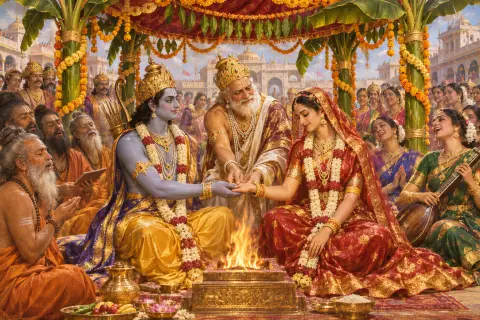
Rama killed the rakshasi Tataka at his word and guarded the sacrifice for six days. Then Vishvamitra led the brothers to Mithila, freeing Ahalya from her curse on the road. In Janaka's hall it was Vishvamitra who asked for the great bow to be shown to Rama. Rama strung it and broke it, and Sita became his wife. The Vivah Panchami page tells that day.
The Gayatri and the Rivers
The Rigveda's third book is attributed to Vishvamitra and his family, the Kushikas. Its hymn 62 ends with the verse to Savitr, the sun as the stirrer, that became the Gayatri mantra: "We meditate on the shining light of the god Savitr; may he stir our thoughts" (3.62.10). The verse is in the gayatri metre, and Vishvamitra is named as its seer. Many Hindus say it at dawn and dusk, and it is taught to boys at the sacred thread ceremony.
Hymn 33 of the same book is a conversation. Vishvamitra, with the Bharata people and their carts, comes to the joined rivers Vipash and Shutudri, today's Beas and Sutlej, in flood. He asks them, as a son to his mothers, to bend down and let the people cross. The rivers answer that they flow where Indra sent them, but at last they agree: they will bow down to him like a nursing mother to her child.
Hymn 53 ends with the verse at the top of this page, "this prayer of Vishvamitra protects the Bharata people". So the sage who was once a king is also remembered as a priest whose words kept a whole people safe.
How to recognise
•A tall, powerfully built sage with a long beard and matted hair piled high, often drawn with a warrior's shoulders and a stern face, as a reminder that he was once a king.
•Saffron or bark garments, a rudraksha mala and a water pot. In scenes with Rama and Lakshmana he walks ahead of the two young princes or sits teaching them, their bows laid beside them.
•He is often painted at sunrise, standing in a river with joined hands, because tradition makes him the seer of the Gayatri, the prayer to the sun said at dawn and dusk.
•Raja Ravi Varma's painting of Vishvamitra turning away from Menaka, who holds out the baby Shakuntala to him, made the scene one of the best known in Indian calendar art.
•In Ramlila he arrives at Dasharatha's court to ask for Rama, and later stands beside Janaka's throne while Rama lifts the bow. Painters of the bow scene usually place him just behind Rama.
Among the hymns also I am the Brihatsaman; among metres Gayatri am I; among the montsh I am the Margasirsha; among the seasons (I am) the flowery season.
Krishna says, "Among metres I am the Gayatri." The Gita speaks of the metre, not of the mantra, and does not name Vishvamitra. But the best known verse in that metre is the Gayatri mantra, whose seer tradition says is Vishvamitra.