The Story
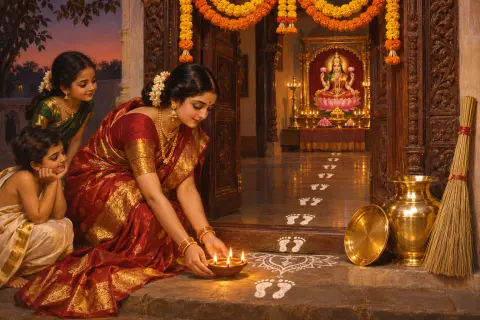
The fullest early description of the Diwali days is in the Padma Purana (Uttara Khanda, chapter 122, titled in translation "The Celebration of Dipavali"). It sets out the five days: a lamp for Yama on the thirteenth of the dark half of Kartika, an early bath and lamps on the fourteenth, and on the new moon a day of worship for the gods and ancestors, ending at night with lamps everywhere. On that night, it says, women should wake Lakshmi before Vishnu wakes from his long sleep, so that she stays in the home for the year, and drive Alakshmi, the goddess of poverty and quarrels, out of the courtyard with music and drums. The next day belongs to Bali and Govardhan, and the day after to Yama and Yamuna. That is the core of the day: a clean, lit home ready to receive Lakshmi. The stories families tell around it come from several sources.
Lakshmi Rises From the Ocean of Milk
The Vishnu Purana (Book 1, chapter 9) and the Bhagavata Purana (Book 8, chapter 8) tell how the gods and the asuras churned the Ocean of Milk, using Mount Mandara as the churning rod and the serpent Vasuki as the rope, to win the nectar of immortality. Many wonders came up from the waters. One of them was Lakshmi, seated on a lotus, holding a lotus in her hand.
The Vishnu Purana says the sages sang her praise, the rivers came to bathe her, and the great elephants of the four directions poured water over her from golden vessels. She looked at the gods and asuras and went to Vishnu, placing a garland of lotuses around his neck. Wherever her gaze rests, the text says, there is prosperity, and where she turns away, there is ruin.
Neither Purana says this happened on the Kartika new moon. The link between Lakshmi's appearance and Diwali night is a later tradition, and some families instead connect her birth with Sharad Purnima. But the story explains why she is welcomed so carefully: she comes to a home that is clean, bright and peaceful, and she does not stay where there is quarrelling and neglect.
Rama Comes Home to Ayodhya
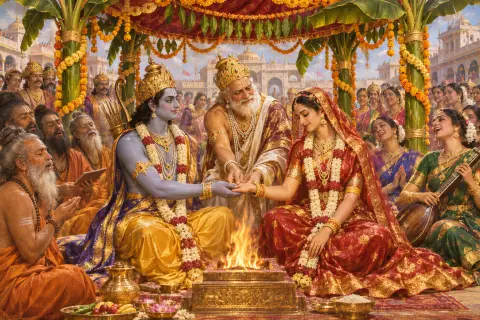
For most families in north India, Diwali is also the night Rama came home to Ayodhya with Sita and Lakshmana after fourteen years in the forest and the war with Ravana. The Valmiki Ramayana tells the homecoming in the closing chapters of the Yuddha Kanda: Bharata has the roads sprinkled with water and strewn with flowers, the city is decked with flags and banners, and the people come out with music to meet their king.
The Valmiki Ramayana does not describe rows of lamps, and it does not tie the return to the Kartika new moon. The picture of Ayodhya lit with diyas to welcome Rama is a later tradition that grew up around the festival, and it is now so loved that for many people it is the meaning of Diwali.
That is worth knowing, not because the custom is wrong, but because it shows how a festival grows. Lamps lit for Lakshmi on the new moon became, in many hearts, lamps lit for Rama. Both welcomes say the same thing: the home is ready, and someone dear is coming in.
Five Days Around One Night
Diwali is the middle of five days, and each has its own page on this site. Dhanteras, on the thirteenth of the dark half, is when people buy metal pots or gold, worship Dhanvantari, who rose from the same ocean churning with the pot of nectar, and set a lamp outside the door for Yama.
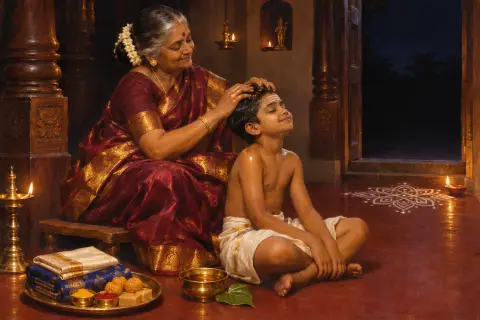
Naraka Chaturdashi, also called Chhoti Diwali or Roop Chaudas, remembers Krishna's victory over the demon king Narakasura with Satyabhama at his side, told in the Bhagavata Purana (Book 10, chapter 59). People bathe before dawn with oil and ubtan. In Tamil Nadu, Karnataka, Andhra Pradesh and Telangana this early oil bath, called Ganga snanam in Tamil homes, is the main Deepavali, with new clothes and crackers before sunrise.
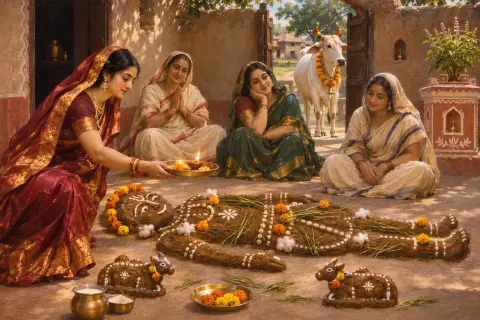
After Diwali comes Govardhan Puja and Annakut, when Krishna's lifting of Govardhan hill is remembered and the cattle are worshipped. In Maharashtra, Karnataka and Gujarat the same day is Bali Pratipada or Padwa, the day of the generous king Bali, and the Gujarati new year. The last day is Bhai Dooj, when sisters put tilak on their brothers, from the story of Yama and Yamuna.
Diwali in Bihar: Lakshmi-Ganesh Puja, Hukka-Paati and Driving Out Poverty
In Bihar the night is centred on Lakshmi-Ganesh puja. New clay idols of the two are bought from the potter, set on a red cloth and worshipped after dusk with kheel (puffed rice), batasha (sugar drops), sweets and lamps. Ganesha is worshipped first, as in every puja, and Lakshmi beside him. Girls build a gharaunda, a small house of clay or wood, decorate it and fill tiny clay pots, the kulia-chukia, with kheel and batasha. Houses are whitewashed and cleaned in the days before, and earthen diyas are lit along the walls, roofs and wells.
In Mithila the night is also called Sukhrati, the night of happiness. After the Lakshmi puja comes Hukka-paati. Family members light a bundle of jute stalks (sanathi) from the lamp in the family shrine, the Gosaunik Ghar, carry it through the house to light the other lamps, and then go out to the main gate together, waving the flame and calling "Lakshmi ghar, daridra bahar" (Lakshmi in, poverty out). Families describe the light as an offering to the ancestors to show them the way. Afterwards the eldest woman of the house blesses the family.
Across Bhojpur and Magadh, before dawn the next morning, the women of the house beat an old winnowing fan (soop) with a stick, going from corner to corner, and leave it outside the house. This is called daliddar khedna, driving out poverty. It is the same idea the Padma Purana describes for this night: Lakshmi is welcomed in, Alakshmi is driven out with noise. Pavapuri in Nalanda district, where Jains remember Mahavira's nirvana, draws pilgrims the same night, and for many Bihari families Diwali begins the six-day countdown to Chhath.
The Same Night in Other Traditions
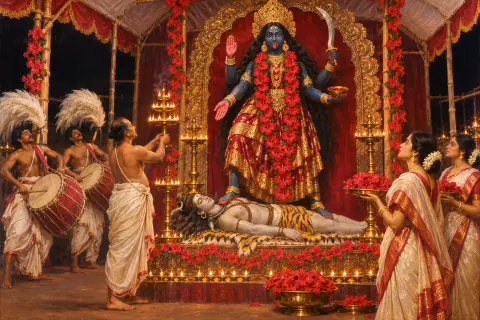
In Bengal, Assam, Odisha and Tripura, the new moon of Kartika is above all Kali Puja (it has its own page). Lamps are lit in the same way, but the night's worship goes to Kali. In Odisha families burn jute stalks and call to their ancestors to come and see the light, a custom close to Mithila's Hukka-paati.
In Nepal, Diwali is Tihar, five days that honour the crow, the dog and the cow, then Lakshmi on the new moon night, with groups of young people going house to house singing Deusi and Bhailo. Newar families do Mha Puja, the worship of one's own body, and begin the Nepal Sambat new year. Tihar ends with Bhai Tika.
For Jains, this is the night of Mahavira's nirvana at Pavapuri. The Kalpa Sutra says that on that new moon night eighteen kings who had gathered there lit lamps, saying that since the light of knowledge had gone, they would make a light of material things. For Sikhs, the same season is Bandi Chhor Divas, remembering Guru Hargobind's release from the fort at Gwalior together with other imprisoned kings, and the Harmandir Sahib in Amritsar is lit with lamps. Each tradition keeps its own reason for the lights, and they sit side by side in the same towns.
In Gita 10.11 Krishna says that out of compassion he lives in the heart and destroys the darkness born of ignorance with the shining lamp of knowledge. A diya on the doorstep is a small version of that promise. Lakshmi is welcomed into a home that has been cleaned and lit, and the inner work is the same: clear out what is stale and quarrelsome, and keep a steady light burning so that something good can come in.