The Story
The oldest full account of Ganesha's birth is in the Shiva Purana (Rudra Samhita, Kumara Khanda, chapters 13 to 18). It says that Parvati made a son from the paste she rubbed off her own body and set him to guard her door, that Shiva cut off his head when the boy would not let him in, and that the gods brought the head of an elephant and brought him back to life. Shiva then made him chief of his ganas and ruled that he be worshipped before every other god. The same chapters say Ganesha was born on a Chaturthi of Bhadrapada at moonrise and set out a vow for that day, which is why the fourth lunar day belongs to him. (The Shiva Purana names the dark half of the month; the great festival everywhere today is kept on the bright half Chaturthi.)
Parvati Makes a Son
The Shiva Purana begins the story on Mount Kailash. Parvati's friends Jaya and Vijaya told her that all the ganas who guarded the house were Shiva's people. They obeyed Shiva first. Parvati, they said, should have someone of her own.
Parvati agreed. From the paste she had rubbed off her body before bathing, she shaped a boy. He was handsome and very strong. She dressed him in ornaments, called him her son and gave him one job: to stand at her door and let nobody in without her word.
Soon Shiva came home and found a stranger at the door. The boy stopped him. Shiva's ganas argued with him, then fought him, and he beat them back. The gods came to help, and in the battle that followed Shiva cut off the boy's head (chapters 14 to 16). The child had only done what his mother asked.
The Elephant Head
When Parvati learned what had happened, her grief turned to fury, and the gods were afraid that she would destroy the world. The sage Narada and the gods begged her for peace. She gave two conditions: her son must live again, and he must be given an honoured place among the gods (chapter 17).
Shiva told the gods to go north and bring the head of the first creature they met. They met an elephant with a single tusk. They fixed its head on the boy's body, sprinkled holy water and chanted Vedic mantras, and the boy woke up as if from sleep. In chapter 18 Shiva makes him the leader of all his ganas, Ganapati, and Brahma, Vishnu and Shiva agree that he will be worshipped first in every rite, and that any rite begun without him will not bear fruit. His name, Shiva says, will remove obstacles.
The Purana itself says the story is told differently in different ages. In the Brahma Vaivarta Purana (Ganapati Khanda) the baby loses his head when Shani, whose look brings misfortune, glances at him, and Vishnu flies out on Garuda to fetch the head of a young elephant. The details change, but every version ends the same way: the son of Parvati is given first place among the gods.
Why Nobody Looks at the Moon Tonight
Ganesh Chaturthi has one unusual rule: do not look at the moon. The Narada Purana (Purva Bhaga, chapter 113, verse 38) says that whoever sees the moon on this Chaturthi will surely face a false accusation, and that to remove the fault one should recite a Puranic verse. The next verse is that remedy: "A lion killed Prasena, and the lion was killed by Jambavan. Do not cry, child, this Syamantaka jewel is yours." The story families tell about the rule is a folk vrata story: Ganesha, full of modaks, fell from his mouse, the moon laughed at him, and Ganesha cursed the moon. When the moon begged forgiveness, the curse was softened to this one night.
The verse points to the story of the Syamantaka jewel, told in the Bhagavata Purana (Book 10, chapter 56). Satrajit received a shining jewel from the sun god. His brother Prasena wore it hunting and was killed by a lion, and the lion was killed by Jambavan, who took the jewel home to his cave. People in Dvaraka whispered that Krishna had killed Prasena for the jewel. Krishna followed the trail into the cave, fought Jambavan for twenty eight days, won back the jewel and married Jambavan's daughter Jambavati, and Satrajit, ashamed, gave him his daughter Satyabhama. The Bhagavata does not mention the moon or Ganesha. The link comes from the vrata tradition, which says Krishna had seen the moon on this night. In Andhra Pradesh and Telangana this Syamantaka story is read aloud at the end of the Vinayaka Chavithi puja, and listeners put a few rice grains on their heads as a blessing.
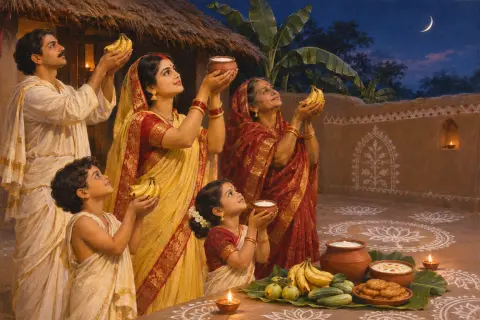
In Mithila, in north Bihar, the same evening is kept the opposite way. On Chaurchan (Chauth Chandra) women fast through the day and, after moonrise, worship the moon in the courtyard with curd, fruits, and sweets in clay pots, holding the offerings up toward the moon. Families say that offering to the moon removes the false blame the moon carries tonight. Chaurchan has its own page on this site.
The Ganesha Purana, the Mudgala Purana and the Scribe
Ganesha has two Puranas of his own, both later than the Shiva Purana: the Ganesha Purana and the Mudgala Purana. They belong to the Ganapatya tradition, devotees who worship Ganesha as the highest god. The Ganesha Purana tells of four forms he takes in the four ages, and its last part includes the Ganesha Gita, a teaching closely modelled on the Bhagavad Gita, with Ganesha in Krishna's place. The Mudgala Purana tells of eight forms, among them Vakratunda, Ekadanta, Mahodara and Lambodara, and each defeats a demon who stands for a human failing such as envy, pride, greed or anger.
The best known Ganesha story outside the Puranas is that he wrote down the Mahabharata as Vyasa recited it, on condition that Vyasa never stop, while Vyasa asked that Ganesha understand every verse before writing it. This scene is found in many manuscripts of the Mahabharata's opening book, but the scholars who prepared the Pune critical edition judged it a later addition and moved it out of the main text. It is still loved, and it is why Ganesha is the patron of writers and students.
From the Home Shrine to the Street
For centuries Ganesh Chaturthi was mostly a household festival. In Pune the Peshwas, whose family deity was Ganesha, kept it with great ceremony. In 1893 Lokmanya Bal Gangadhar Tilak used his newspaper Kesari to promote a public, ten day Ganeshotsav, with the image in a shared pandal, music, lectures and a common immersion procession, as a way of bringing people together under British rule. Some Pune mandals, such as Bhausaheb Rangari's, say they set up public images a year or more before Tilak's call, and the question is still argued. Pune's five "manache Ganpati" (the honoured Ganpatis: Kasba, Tambdi Jogeshwari, Guruji Talim, Tulshibaug and Kesariwada) still lead the city's immersion procession in that order.
The idea spread far. In Mumbai, Lalbaugcha Raja was set up in 1934 by fishermen and vendors of the Lalbaug market area, and devotees now queue for many hours to see it. In Hyderabad, the Khairatabad Ganesh began in 1954 as a one foot image and was made one foot taller each year for decades, until it became one of the tallest in India. In Goa, Chavath is still mainly a family festival: people return to their ancestral homes, and the image sits under a matoli, a canopy hung with fruits, gourds and forest plants. In Karnataka, Gauri Habba is kept the day before, honouring Parvati before her son arrives. In Tamil Nadu, Vinayagar Chaturthi means small clay images bought from roadside stalls and kozhukattai, steamed rice dumplings. In Andhra Pradesh and Telangana, Vinayaka Chavithi puja uses twenty one kinds of leaves (patri).
As the images grew bigger, so did the harm to rivers, lakes and the sea from plaster of Paris and chemical paints. Many families and mandals have gone back to natural clay (shadu) and plant colours, immerse in a bucket at home or in artificial tanks, and India's Central Pollution Control Board has issued guidelines for idol immersion. In Bihar, public Ganesh pandals are now common in Patna and many towns, often run by neighbourhood committees with evening aarti and an immersion procession, while in Mithila the night still belongs above all to Chaurchan.
Parvati made Ganesha from the earth of her own body, and every year families make him again from clay, honour him for a few days, and give him back to the water. In Gita 2.28 Krishna says beings are unseen before birth, seen in between, and unseen again at the end, so why grieve? The visarjan acts this out with love: nothing is lost when the form returns to the water, and "Ganpati Bappa Morya, come back soon next year" is a farewell with no fear in it.