The Story
Karva Chauth has no story in the Vedas or the major Puranas. The best known written references are in later Sanskrit handbooks on vows, the Nirnaya Sindhu, the Dharma Sindhu and the Vratraj, which call it Karak Chaturthi. Karak is the Sanskrit word for the karva, the small spouted clay pot that gives the day its name. These books describe the fast for the wellbeing of the husband and the family, the evening puja of Parvati, Shiva, Ganesha and Kartikeya, and the gift of a karva filled with water or milk. The stories told at the evening puja come from the vrat katha tradition, passed on by women and printed in small katha booklets, and they change a little from family to family.
Veeravati and the False Moon
The story read most often is about Veeravati, the only sister of seven brothers. In the version printed by Drik Panchang, her father is a Brahmin named Vedasharma who lives in Indraprastha. Veeravati is newly married and is at her parents' home for her first Karva Chauth. She fasts with her sisters in law, but by evening she is so weak with hunger and thirst that she faints.
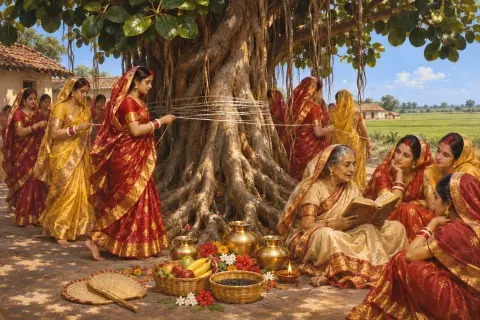
Her brothers cannot bear to see her like this. One of them climbs a distant tree with a lamp and a sieve, and the light glowing through the leaves looks like the rising moon. The others wake her and say the moon is up. Veeravati offers water to the lamp, believing it is the moon, and sits down to eat. With the first bite she finds a hair, with the second she sneezes, and with the third a message arrives that her husband has died.
She runs to her husband's home and sits by his body, weeping and blaming herself. Indrani, the wife of Indra, comes to her and explains that she broke the fast before giving arghya to the real moon. Indrani tells her to keep the Chauth fast every month for a year, together with the next Karva Chauth. Veeravati does so faithfully, and her husband is brought back to life. In some homes it is Parvati who appears instead of Indrani, and the tree is a banyan or a pipal, but the heart of the story stays the same.
Karva and the Crocodile
A second vrat katha is about a devoted wife named Karva. Her husband went to bathe in the river, and a crocodile seized his leg and began to drag him under. Karva ran to the bank, tied the crocodile up with a cotton thread and held it there.
Then she went to Yama, the god of death, and asked him to send the crocodile to its death and spare her husband. When Yama hesitated, she said she would curse him. Yama, afraid of the power of a faithful wife, sent the crocodile to his realm and gave her husband a long life. Many families say this is why women pray to Karva Mata on this day. This story is folk tradition, and it is not found in any Purana.
Savitri, Who Followed Yama
The story of Savitri is older and has a clear source. It is in the Mahabharata (Aranyaka Parva, the Pativrata Mahatmya, chapters 277 to 283 in the critical edition), where the sage Markandeya tells it to the Pandavas in exile. Savitri, a princess, chooses to marry Satyavan even after she is told he will die within a year. On the day he dies, Yama comes to take his life, and Savitri follows Yama on foot, speaking to him so wisely about dharma that he grants her boons one after another, until he has to give Satyavan back.
Savitri's own vow is Vat Savitri, kept in the month of Jyeshtha, not Karva Chauth. But women often name her at the Karva Chauth puja as the model of a wife whose love and courage turned back death, and some katha booklets include her story. The link with Karva Chauth is a devotional tradition, not part of the Mahabharata.
Draupadi and Krishna
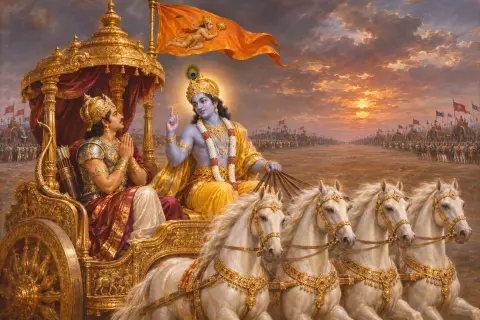
Another katha connects the fast with the Pandavas. Arjuna had gone to the Nilgiri mountains to do penance, and the other Pandavas were facing one trouble after another. Draupadi, worried, prayed to Krishna. Krishna told her that Parvati had once asked Shiva the same question, and Shiva had told her about the Karva Chauth fast. He then told Draupadi the story of Veeravati.
Draupadi kept the fast, and the Pandavas' troubles eased. This conversation is not in the Mahabharata. It is part of the vrat katha tradition, which often places its stories in the mouths of Krishna, Shiva or other great figures to show how important the vow is.
How the Day Is Kept, From Punjab to Rajasthan
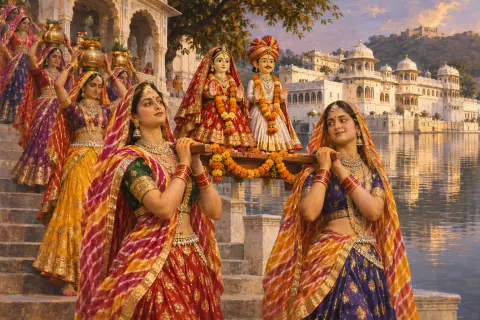
In Punjab and Haryana the day begins before dawn with sargi, a meal sent by the mother in law: sweets, fruit, dry fruit, mathri and feni (fine vermicelli). After that the wife takes no food or water. In the afternoon or evening, women dressed as brides gather in a circle and pass their puja thalis around while singing a traditional Karva Chauth song, and an older woman tells the katha. The bride gives her mother in law a baya, a gift of sweets, clothes or money.
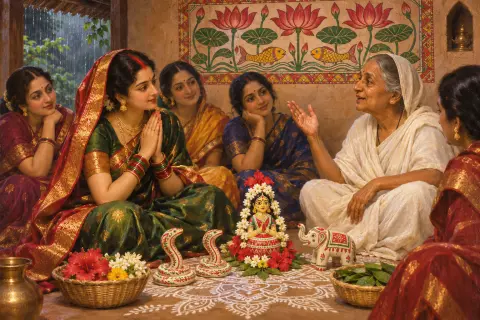
In Uttar Pradesh and Rajasthan many women draw Gaura and Chauth Mata on the wall or use a printed Karva Chauth picture, and some make a small Gaur Mata of clay. In Rajasthan the goddess has a well known temple at Chauth Ka Barwara in Sawai Madhopur district. The karva itself is filled with water, sometimes with a coin or sweets inside, and after the puja it is given to a married woman or a Brahmin with the mantra above.
When the moon rises, the wife looks at it, often through a sieve, offers water from the karva as arghya, and then looks at her husband. He gives her the first sip of water and the first bite of food. In Bihar and eastern Uttar Pradesh the custom was traditionally less common, since women there keep Hartalika Teej for the same prayer, though Karva Chauth is now seen in their cities too. Films and television have made it popular far beyond the north, and today many husbands fast alongside their wives.
In the Gita (9.26) Krishna says that whoever offers him a leaf, a flower, a fruit or a little water with love, he accepts. The karva of water offered to the moon is that kind of offering. What gives it worth is the love behind it, not how hard the fast is, and a fast kept with care for one's health is kept just as truly.