The Story
The best known story of Shivaratri is in the Shiva Purana (Koti Rudra Samhita, chapter 40). It tells of a hunter named Gurudruha who, without knowing it was Shivaratri, went without food, stayed awake all night in a bilva tree and kept dropping water and bilva leaves onto a Shiva linga below, and so completed the worship of all four watches of the night by accident. Shiva freed him, and the chapter ends by calling the Shivaratri vow the greatest of vows. A shorter version in the Garuda Purana (part 1, chapter 124) names the hunter Sundarasena. That is why people fast, stay awake and offer water and bilva leaves on this night.
The Hunter in the Bilva Tree
Gurudruha was a hunter with a large family and a hard life, and he had never done anything holy. One day his parents and wife, weak with hunger, begged him to bring food. He went into the forest with his bow, but found nothing all day. It was Shivaratri, though he did not know it. As the sun set he climbed a bilva tree beside a pond, with some water, and waited for an animal to come and drink.
In the first watch of the night a doe came. As he drew his bow, some water spilled and a few bilva leaves fell. Under the tree, unseen, stood a Shiva linga, and the Shiva Purana says this became his worship for the first watch. The doe begged to go home first and leave her fawns with her family, swearing to come back, and he let her go. In the second watch her sister came looking for her, and in the third a stag. Each time he aimed, each time water and leaves fell on the linga, and each time the animal promised to return.
He never slept. He had eaten nothing. Without meaning to, he had fasted, kept the vigil and worshipped Shiva in every watch of the night.
The Deer Keep Their Word
Near dawn, all three deer came back together, with the fawns following behind. Each one offered to die so the others could live. Once more the hunter raised his bow, and once more leaves and water fell, completing the worship of the fourth watch.
Then, the Purana says, his heart changed. 'These deer have no learning, yet they give their own bodies for others. I was born human, and I have fed my family by hurting others,' he thought. He lowered his bow and told the deer to go home in peace.
Shiva appeared before him, pleased with the vow he had kept without knowing it. He gave him the name Guha and said that he would live at Shringaverapura and that Rama himself would one day come to his home as a friend. This is the same Guha, the boatman chief who welcomes Rama in the Ramayana. The deer, too, were freed. People tell this story on Shivaratri to show how much even a little sincere worship on this night can mean.
The Column of Light Without End
Another story many people connect with this night is the appearance of Shiva as an endless column of fire. It is told in the Linga Purana (first part, chapter 17) and in the Shiva Purana (Vidyeshvara Samhita, chapters 6 to 9). Brahma and Vishnu argued over which of them was greater. Suddenly a pillar of fire rose between them, with no visible top or bottom. Brahma became a swan and flew up to find its top. Vishnu became a boar and dug down to find its root. Neither found an end.
Then Shiva appeared from the column, and both bowed to him. The column became the first linga, the reason Shiva is worshipped in the form of a linga to this day. In the Shiva Purana, Brahma also falsely claimed he had seen the top, with a ketaki flower as his false witness, which is why that flower is not offered to Shiva.
Accounts differ on the date. In the same chapter of the Shiva Purana (Vidyeshvara Samhita 9), Shiva praises worship on Shivaratri, saying it gives the fruit of a whole year of worship, but he places the day of the column of fire on the Ardra star in the month of Margashirsha, and links the column to the Arunachala hill at Tiruvannamalai. The popular belief that the column appeared on Maha Shivaratri night is widespread, but it comes from later tradition, not from that chapter.
The Wedding and the Poison
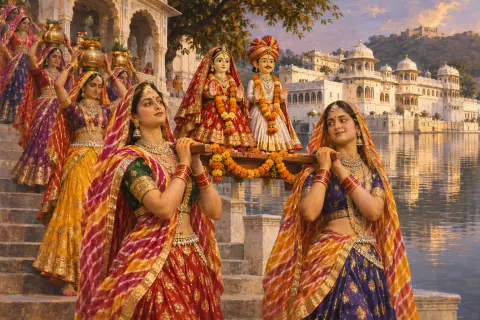
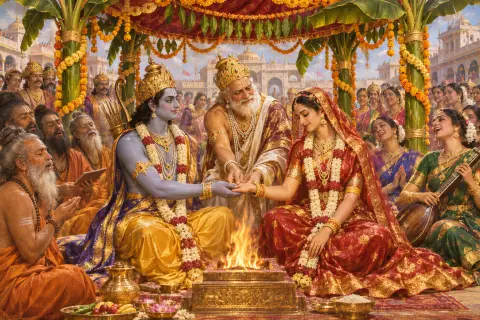
Across north India, and above all at Deoghar, Maha Shivaratri is celebrated as the night of Shiva's wedding to Parvati. The wedding itself is told at length in the Shiva Purana (Rudra Samhita, Parvati Khanda), but the Purana does not set it on this night. Linking the two is a living popular tradition, and it is why so many towns hold a Shiv barat, a wedding procession for Shiva, on Shivaratri.
Another story often told on this night is that of Neelakantha, the blue-throated one. When the gods and asuras churned the ocean for nectar, a deadly poison, halahala, rose first and began to burn the worlds. Shiva drank it to save everyone, and it left a blue mark on his throat (Bhagavata Purana, book 8, chapter 7). Many retellings add that Parvati held his throat so the poison would not go down. It is a separate story, and the texts do not place it on Shivaratri, but many families tell it as a reason to stay awake and pray through this night.
Each story shows a different side of Shiva: the ascetic who becomes a bridegroom, the god who takes in poison so that others can live, and the lord who is moved by a hunter's accidental worship.
Baba Baidyanath, Bihar and Mithila
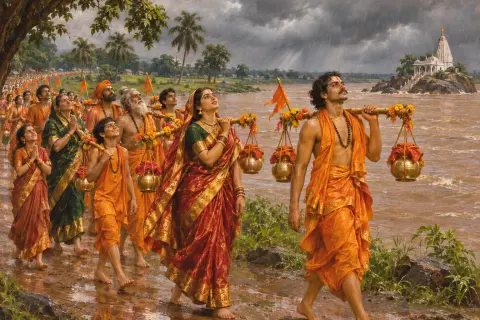
For Bihar, the heart of Shivaratri is Baba Baidyanath Dham at Deoghar. Deoghar has been in Jharkhand since 2000, but it was part of Bihar for generations and remains deeply tied to it. The temple is counted among the twelve jyotirlingas (Parli in Maharashtra also claims the name Vaidyanath). Every Shravan, lakhs of kanwariyas carry Ganga water about 105 km on foot from Sultanganj in Bihar to pour on the linga here. On Shivaratri the town celebrates Shiva's wedding: the panchshul, the five-pointed finials on top of the temples, are taken down, worshipped and put back in the days before, a mor mukut (peacock crown) is placed on the main spire, red cloth ties the Shiva temple to the Parvati temple, and a grand Shiv barat winds through the streets.
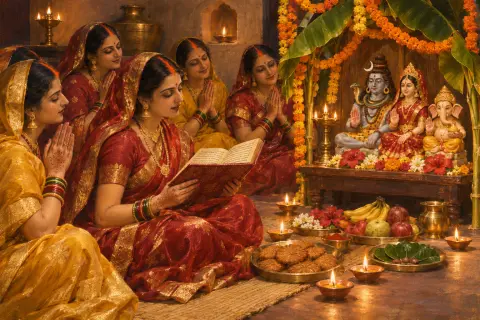
Towns across Bihar hold their own Shiv barat. People dress as Shiva's companions, ghosts, Nandi and the gods, with a Shiva bridegroom at the centre, and the procession goes with drums and songs to a Shiva temple. Temples like Baba Garib Nath in Muzaffarpur draw long queues of people with water pots from before dawn, and in homes people fast and offer bilva leaves, datura, ber and milk.
In Mithila, Shiva is loved in a very personal way. A Maithili tradition says that Shiva came to the poet Vidyapati in disguise as a servant named Ugna. Once, when the poet was dying of thirst on the road, Ugna gave him water that tasted of the Ganga, drawn from his own matted hair, and Vidyapati knew who he was. Shiva made him promise to keep the secret. Later, when Vidyapati's wife scolded and struck Ugna with a stick, the poet cried out that he was Shiva, and Ugna vanished. The Ugna Mahadev temple at Bhawanipur, near Pandaul in Madhubani district, remembers this. Vidyapati's songs to Shiva, the nachari, are still sung in Mithila on Shivaratri.
In the Gita (10.23) Krishna says, 'Among the Rudras I am Shankara.' The hunter knew no prayers and no scripture. He was hungry, awake and a little kinder by morning, and that was enough for Shiva to come to him. Shivaratri says that one sincere night, a fast, a few leaves and a pot of water can be a real offering.