The Story
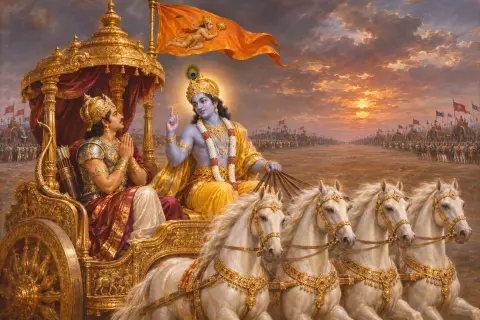
The day is set by the sun, not by one story, so its oldest written roots are in the Mahabharata. In the Bhagavad Gita (8.24), Krishna calls the six months of Uttarayana, the sun's northern course, the bright path. In the Anushasana Parva (sections 167 and 168 in K. M. Ganguli's translation), Bhishma, who had lain on his bed of arrows for fifty eight nights, sees that the sun has begun its northward course and the month of Magha has come, and only then gives up his life. Makar Sankranti, the day the sun enters Makara, is kept as the start of that bright half of the year, with river baths, sesame and gifts to the poor.
The Sun's Turn and Bhishma's Wait
Sankranti means the sun's move from one zodiac sign to the next. There are twelve in a year, but the move into Makara matters most, because tradition counts Uttarayana, the six months when the sun travels north and the days grow longer, from this day. In the Vedic way of seeing the year, Uttarayana is the bright half, the path of the gods, and Dakshinayana, the other half, is the path of the ancestors.
Strictly speaking, the sun's real turn to the north, the winter solstice, now comes around 21 December. The two dates have drifted apart over many centuries because the earth's axis slowly wobbles, but the festival still follows the sun's entry into Makara as the old calendars reckoned it.
The Mahabharata gives the day its best known story. Bhishma, the grand old man of the Kuru family, had been granted the power to choose the moment of his death. Wounded at Kurukshetra, he lay on a bed of arrows and waited for Dakshinayana to end. While he waited he taught Yudhishthira about kingship, duty and life, teachings that fill the Shanti Parva and the Anushasana Parva. When the sun had turned north and Magha had come, he took leave of his family and let go of his life. His death is remembered on Bhishma Ashtami, the eighth day of the bright half of Magha, a few weeks after Sankranti.
Sesame, Jaggery and Speaking Sweetly
"Tilgul ghya, god god bola", say people in Maharashtra: take this sesame and jaggery, and speak sweetly. Across western, central and northern India, neighbours, friends and even strangers hand each other til gul, tilkut, gajak or sesame laddoos on this day. It is food, a small act of making up and a kind of offering, all at once.
Sesame and jaggery suit the season. Both give warmth and energy in the coldest weeks of the year. When you give a sweet and ask someone to speak kindly, you are quietly closing whatever hard words the old year held.
Giving is at the centre of the day. Many people count Sankranti among the best days of the year for daan, and give blankets, warm clothes, grain, khichdi and sesame sweets to people who need them. The idea is simple: the sun gives more light, the earth gives the harvest, so people give too. The Gita (3.14) describes this same circle of giving that keeps the world going.
Kites, Rivers and Many Names
In Gujarat the day is Uttarayan, and it belongs to kites. From early morning, rooftops in Ahmedabad, Surat and countless villages fill with families flying kites, cutting each other's strings with glass coated manja, and eating undhiyu and chikki. Gujarat Tourism holds an International Kite Festival in Ahmedabad around this time. Jaipur and much of Rajasthan fly kites on the same day.
In Bihar and eastern Uttar Pradesh the day is Tila Sankranti, or simply Khichdi. After a morning bath, families eat dahi chura, flattened rice with curd and jaggery, along with tilkut, a sesame sweet for which Gaya is famous. In the evening they cook khichdi of rice and lentils, and give rice, lentils and sesame to priests and the poor. At the Gorakhnath temple in Gorakhpur, devotees offer khichdi to Baba Gorakhnath, and a large fair grows around it.
In Bengal, pilgrims crowd onto Sagar Island for the Gangasagar Mela, where the Ganga meets the sea, to bathe and visit the temple of the sage Kapila. Local tradition links the place to the story told in the Ramayana: the Ganga, brought down by King Bhagiratha, flowed to the ashes of his ancestors, the sons of Sagara, and freed them.
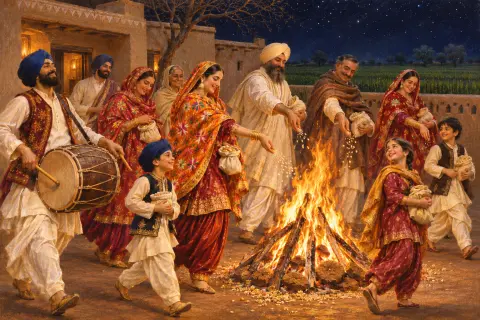
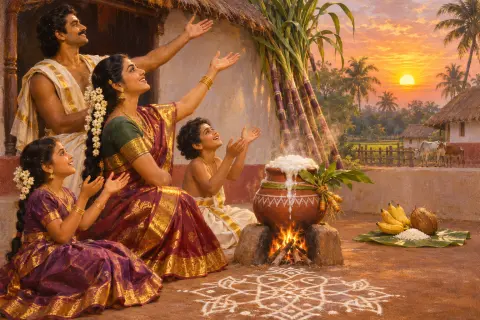
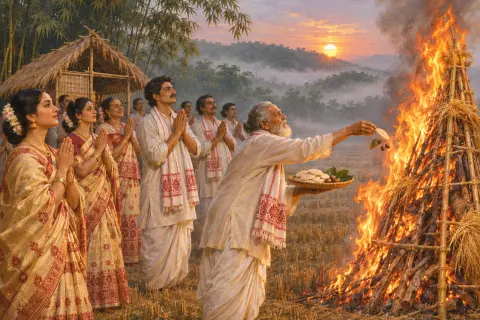
Other regions have their own festival for the same turn of the sun, and several have pages of their own on this site. In Punjab, Lohri is lit the night before and the day itself is Maghi. Assam keeps Magh Bihu, with a night of feasting and a morning bonfire. Tamil Nadu keeps Pongal over several days, and Andhra Pradesh and Telangana keep Sankranti with Bhogi fires the day before. In Nepal it is Maghe Sankranti.
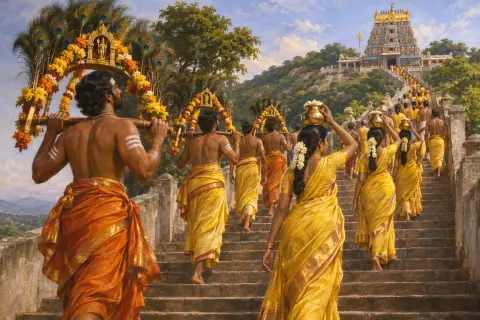
Water ties most of these together. Across India people bathe at dawn in the Ganga, Yamuna, Godavari, Krishna and Kaveri. At Prayagraj the Magh Mela at the Triveni Sangam, where three rivers meet, draws huge crowds, and Makar Sankranti is one of its main bathing days.
Keeping the Day at Home
Makar Sankranti needs very little. A bath, a little water offered to the rising sun, a handful of sesame and a piece of jaggery are enough. There is nothing to decorate and nothing to show off.
What it asks of you is to give. The question of the day is not what you received but what you gave: a blanket for someone who is cold, a meal for someone who is hungry, a kind word for someone you have fallen out with.
For children, the day is an easy way to see that people live by the sun and the seasons. A child flying a kite on Sankranti morning learns, without a lecture, that the same sky that lifts the kite brings the rain that grows the rice on the family's plate.
Bhishma could have died whenever he wished, and he chose to wait for the sun's bright half. Makar Sankranti asks for that kind of patience and that kind of turning: towards light, towards kindness, towards giving. In the Gita (3.14), all beings live by food, food comes from rain and rain from offering. A sweet shared, a blanket given and a prayer to the rising sun are small ways of keeping that circle going.