The Story
The oldest written mention of a festival called Onam is in Maduraikanchi, a Sangam-era Tamil poem, which describes Onam being kept in Madurai in honour of Vishnu (Mayon) with new clothes, feasting and games. The story Malayalis tell about Onam comes from the Bhagavata Purana (Canto 8, chapters 15 to 23): Vishnu, born as the dwarf Vamana, asked the generous king Mahabali for three steps of land and took the three worlds with them, and Mahabali kept his word to the end. In the Bhagavata, Vishnu then sends Mahabali to rule Sutala, a world below the earth. The belief that Mahabali comes back to Kerala once a year to see his people is Kerala's own tradition, not something the Bhagavata says, and it is the reason Onam is kept.
The King Who Won Heaven
Mahabali, usually just called Bali in Sanskrit, was the son of Virochana and the grandson of Prahlada, the devotee whom Vishnu saved as Narasimha. He was an asura king, but the Bhagavata describes him as truthful, devoted to brahmins and famous for giving. With the help of the brahmins of the Bhrigu family he performed great sacrifices and grew so strong that he drove Indra and the gods out of heaven and ruled all three worlds (Bhagavata 8.15).
Aditi, the mother of the gods, was heartbroken to see her sons homeless. On the advice of her husband, the sage Kashyapa, she kept a twelve day vow called payovrata and prayed to Vishnu (8.16). Vishnu appeared to her and said that he would be born as her son and set things right, since for now Bali was protected by his own good conduct and by the brahmins who stood with him (8.17).
The Boy at the Sacrifice
Vishnu was born to Aditi as Vamana, a small brahmin boy. The Bhagavata says he appeared on the twelfth day of the bright fortnight when the moon was in the Shravana star (8.18.5). In Malayalam that star is Thiruvonam, and it is the star of Onam's main day. Kerala tradition draws this link; the Bhagavata itself does not mention Kerala.
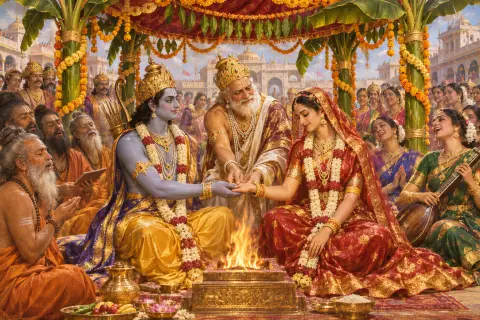
Wearing a deerskin, a sacred thread and a belt of munja grass, and carrying an umbrella, a staff and a water pot, Vamana walked to Bali's sacrifice at Bhrigukaccha on the north bank of the Narmada (8.18). Bali welcomed him, washed his feet and told him to ask for anything: land, gold, cattle, a village (8.18 to 19). Vamana asked only for as much land as he could cover in three of his own steps (8.19).
Bali's guru, Shukracharya, saw who the boy really was. He warned Bali that these three steps would take everything he had and give it to Indra. Bali answered that he had already given his word, and that breaking a promise to a brahmin who had come to ask was worse than losing his kingdom. Shukracharya cursed him to lose his wealth soon. Bali still went ahead: his wife Vindhyavali brought a golden pot of water, Bali washed Vamana's feet and poured water to seal the gift (8.20.14 to 18).
Three Steps
Then the small boy began to grow. He became Trivikrama, the one of the three strides. With one step he covered the whole earth, with the second the heavens, and there was no place left for the third (8.20.33 to 34). Bali's followers took up arms, and Garuda bound Bali with the ropes of Varuna (8.21).
Bali was not angry and did not plead. He said: if you think my promise has turned out false, I will make it true. Place your third step on my head (8.22.2). That is the verse given at the top of this page. Prahlada arrived and praised Vishnu for taking away a kingship that had made his grandson proud, and Vindhyavali prayed for her husband (8.22).
Vishnu was pleased. He said Bali had shown a patience even the gods find hard, gave him Sutala, a world built by Vishvakarma where there is no sorrow or sickness, and promised that he would become Indra in a future age, the reign of Savarni Manu (8.22.31 to 32). He also promised to stay with Bali and protect him there, so that Bali could always see him (8.22.35). Many retellings say Vishnu agreed to stand at Bali's door as his gatekeeper. Bali bowed and went to Sutala with Prahlada (8.23).
What Kerala Remembers
Kerala tells the story with its own heart. In the Malayali telling, Maveli (Mahabali) ruled this land, and his reign was a golden age. An old folk song, sung at every Onam, begins: when Maveli ruled the land, all people were alike. No one lied, no one cheated, no one went hungry. Before he left, the story goes, Mahabali asked to be allowed to visit his people once a year. Onam is the time he comes, and Kerala dresses its homes to show him they are still happy.
This annual visit is a Kerala belief, and it is worth being clear about that. The Bhagavata sends Bali to Sutala and says nothing about a yearly return or about Kerala. Malayalis do not need it to: the visit is a family story the whole state shares, and it has been told for centuries.
Vamana is not forgotten either. The Thrikkakara Vamana temple near Kochi has Vamana as its main deity and is seen as the home of Onam. Its festival begins with a flag hoisting on Atham and ends on Thiruvonam. In homes, families set out small pyramid shaped clay figures called Thrikkakarappan in the courtyard. Some say the figures stand for Vamana, others for Mahabali; families differ, and both are honoured.
Ten Days, a Feast and a Boat Race
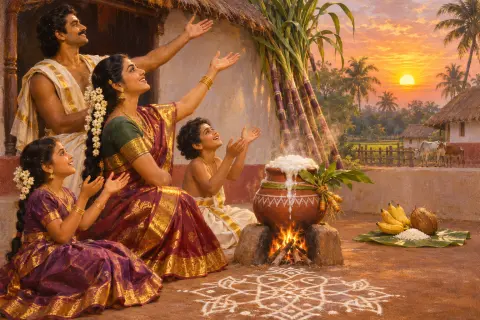
Onam starts on Atham. In Thripunithura near Kochi, the Athachamayam procession, once led by the Kochi royal family, opens the season. At home the pookalam begins small, often a single ring of flowers on the first day, and grows a ring or a colour each day until it is a large carpet on Thiruvonam. The day before Thiruvonam, Uthradom, is called first Onam and is the busiest day for shopping and cooking.
On Thiruvonam families wear new clothes, often a gift from the eldest called onakkodi, and sit on the floor for the Onasadya. On a banana leaf come banana chips, sharkara varatti, pickles, rice, parippu with ghee, sambar, avial, olan, kalan, thoran, pachadi, pulissery, erissery, pappadam and at least one payasam, often more than twenty items in all. There is an old saying: kaanam vittum onam unnanam, even if you have to sell your land, you must eat the Onam feast.
The days after carry on. At Aranmula on the Pampa river, the snake boats called palliyodams of the Parthasarathy temple row in the Uthrattathi Vallamkali on the Uthrattathi star, a few days after Thiruvonam, with the rowers singing boat songs. (The famous Nehru Trophy race in Alappuzha is a separate event held in August.) In Thrissur on fourth Onam, men painted as tigers dance through Swaraj Round in the Pulikali, a custom local tradition credits to the Kochi ruler Sakthan Thampuran. Women in kasavu sarees dance the Kaikottikali, clapping in a circle around a lit lamp. Hindus, Christians and Muslims all keep Onam as Kerala's own festival, and the sadya is shared across every community.
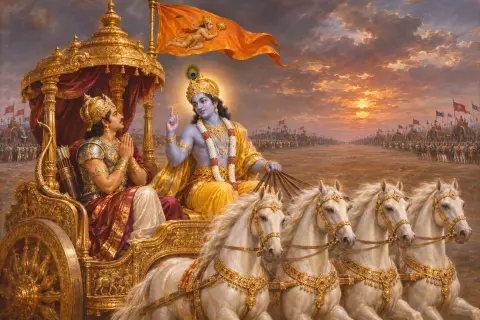
Mahabali lost the three worlds to a boy he had welcomed, and he did not hate him for it. He kept his word, bowed his head, and is remembered for a kingdom where everyone was treated alike. In Gita 6.9 Krishna says the best person keeps the same mind toward friends and enemies, relatives and strangers, the good and the wrong. Onam, which Malayalis of every faith share at one long banana leaf, asks for that same even heart.