
Balarama
Krishna's elder brother, the plough-bearer
Balarama is the elder brother of Krishna, the son of Vasudeva and Rohini, known by his plough and his pestle-club, his fair skin and his blue clothes. The Mahabharata calls him a portion of Shesha, the serpent who holds up the world, and the Bhagavata Purana tells his boyhood with Krishna in Vraja and his great feats of strength. He taught the mace to both Bhima and Duryodhana, refused to fight at Kurukshetra and went on a pilgrimage instead. Many lists of Vishnu's ten avatars include him, and at Puri he is worshipped as Balabhadra, whose chariot leads the Rath Yatra.
Also called: Baladeva, Balabhadra (the strong and good, his name at Puri), Sankarshana (the one drawn out, from his transfer between wombs), Rama, Haladhara and Halayudha (bearer of the plough), Musali (with the pestle), Rauhineya (son of Rohini), Revatiramana (beloved of Revati), Taladhvaja (with the palm-tree banner), Dauji (elder brother, in Braj)
Father: Vasudeva; mother: Rohini, who carried him after he was moved from Devaki's womb
Brother: Krishna; sister: Subhadra, later the wife of Arjuna
Wife: Revati, daughter of King Kakudmi (Raivata)
Students: Bhima and Duryodhana, both taught the mace by him
Divine identity: a portion of Shesha, the serpent Ananta (Mahabharata, Adi Parva); counted in many lists among Vishnu's avatars
Weapons: the plough and the pestle; banner: the palm tree; home: Vraja, then Mathura and Dwaraka
वहसि वपुषि विशदे वसनं जलदाभम्। हलहतिभीतिमिलितयमुनाभम्॥ केशव धृतहलधररूप जय जगदीश हरे॥
vahasi vapuṣi viśade vasanaṃ jaladābham, halahatibhītimilitayamunābham, keśava dhṛtahaladhararūpa jaya jagadīśa hare.
On your fair, shining body you wear clothes the colour of a rain cloud, like the Yamuna who came running in fear of your plough. O Keshava, who took the form of the plough-bearer, victory to you, lord of the world, Hari.
Stories
Balarama appears in the Mahabharata, mostly at its edges: at weddings and councils, on his pilgrimage during the war, at the mace duel at its end, and in the Mausala Parva, which tells his death. His fullest story is in the Harivamsa and the Bhagavata Purana, which follow him through childhood in Vraja and his life in Dwaraka. Below, Mahabharata section numbers follow K. M. Ganguli's English translation of the vulgate, with Critical Edition numbers from Pune where they help, and Bhagavata references are to book, chapter and verse. Later devotion added his place in the avatar lists, the Puri triad, and the temple at Baldeo near Mathura.
The child drawn from one womb into another
King Kamsa had locked up his sister Devaki and her husband Vasudeva and killed their first six sons. When Devaki carried her seventh child, Vishnu sent Yogamaya to draw the unborn baby out of her womb and place it in the womb of Rohini, Vasudeva's other wife, who lived safely in Gokul. People thought Devaki had miscarried. Because he was drawn out, the child was called Sankarshana; because he would delight people, Rama; and because of his strength, Balabhadra (Bhagavata Purana 10.2.8 to 13).
The Mahabharata says that the mighty Baladeva was a portion of Shesha, the serpent, while Krishna was a portion of Narayana (Adi Parva, section 67; Critical Edition 1.61.91). So the two brothers grew up together among the cowherds of Vraja, the fair one and the dark one.
Boyhood in Vraja
In the Bhagavata the brothers herd calves and cows together and face demons together. When the cowherd boys wanted the fruit of the Talavana palm grove, guarded by the donkey demon Dhenuka, Balarama shook the trees, caught Dhenuka by the hind legs when he kicked, whirled him round and threw him into a palm tree (Bhagavata 10.15).
Another day the demon Pralamba joined the boys' game disguised as a cowherd. The losers had to carry the winners, and Pralamba, on the losing side, chose to carry Balarama and ran far past the mark. Balarama made himself as heavy as Mount Meru, the demon showed his true form, and Balarama struck his head with his fist and killed him (10.18.24 to 29). Later, at Kamsa's wrestling match in Mathura, Balarama killed the wrestler Mushtika while Krishna fought Chanura (10.44).
The Yamuna and the plough
Years later Balarama came back alone from Dwaraka to Vraja and stayed two months, Chaitra and Vaishakha, spending the moonlit nights with the cowherd women in a garden by the Yamuna (Bhagavata 10.65.17 to 18). Varuna sent the drink varuni flowing from a tree, and Balarama, merry with it, called the Yamuna to come so he could play in her waters.
The river did not come, thinking he was drunk. Angry, he hooked the tip of his plough into her and dragged her toward him: since you do not come when I call, I will bring you here in a hundred streams. Frightened, the goddess Yamuna came and fell at his feet, saying she had not known his greatness, he who holds up the earth with a single portion of himself. He let her go and played in her waters, and the goddess Kanti gave him blue clothes and a gold necklace (10.65.24 to 32). The Bhagavata adds that the Yamuna still flows in the channels he cut (10.65.33).
Teacher of the mace
Balarama was the great master of the mace. In the Bhagavata, after a quarrel over the Syamantaka jewel, he spent some years in Mithila, and Duryodhana came there to learn the mace from him (10.57). In the Mahabharata he calls both Bhima and Duryodhana his students in the mace (Udyoga Parva, section 158).
He was fond of Duryodhana and often on the Kauravas' side in small things. When Duryodhana imprisoned Krishna's son Samba for carrying off his daughter Lakshmana, Balarama went to Hastinapura to make peace. The Kauravas mocked the Yadavas, and Balarama dug his plough into the city and began to drag it toward the Ganga. The Kurus released Samba and Lakshmana and begged his forgiveness. The Bhagavata says the city is still raised on its southern side along the Ganga (10.68).
A pilgrimage instead of war
Just before Kurukshetra, Balarama came to the Pandava camp. He said he had told Krishna again and again to treat Duryodhana and the Pandavas alike, but Krishna had chosen Arjuna's side. Both Bhima and Duryodhana are my students, he said, and I love them equally. I cannot watch the Kurus destroyed, so I am going to bathe at the sacred places on the Sarasvati (Udyoga Parva, section 158; Critical Edition 5.154).
He travelled along the Sarasvati for forty-two days, giving gifts at its holy places, and the Shalya Parva uses his journey to tell the stories of each place (sections 35 to 54; Critical Edition 9.34 to 53). He came back on the last day of the war, just as Bhima and Duryodhana met with their maces. When Bhima broke Duryodhana's thighs with a blow below the navel, against the rules of mace fighting, Balarama raised his plough and rushed at Bhima. Krishna held him back and calmed him, and Balarama left in anger for Dwaraka, saying Bhima would be known as an unfair fighter and Duryodhana would go to heaven (section 60; Critical Edition 9.59).
The white serpent, and the chariot at Puri
After the Yadavas destroyed one another in a drunken brawl at Prabhasa, Krishna went looking for his brother and found him sitting alone under a tree in yoga. From Balarama's mouth came a great white serpent with a thousand heads and red eyes, which left the human body and went into the ocean, where the ocean and the serpent kings received it (Mausala Parva, section 4; Critical Edition 16.5). Shesha had gone home.
Devotion kept him close. Jayadeva's Gita Govinda, in the 12th century, names him as the eighth of Vishnu's ten avatars, between Rama and the Buddha, though many lists put Krishna in that place. At Puri he is worshipped as Balabhadra, Jagannath's elder brother with a white face, and at the Rath Yatra his chariot Taladhwaja goes first. In Braj he is Dauji, the elder brother, with a famous temple at Baldeo near Mathura.
How to recognise
- •Fair, almost white skin, in contrast to his dark brother. The Shalya Parva compares him to the crest of a white cloud, Jayadeva calls his body bright (vishada), and at Puri Balabhadra's face is painted white.
- •Blue clothes. The Bhagavata (10.65) says the goddess of beauty gave him blue garments after he bathed in the Yamuna, and Jayadeva compares their colour to a rain cloud.
- •A plough (hala) in one hand and a pestle-club (musala) in the other. These are his weapons in the epic and the Puranas: he drags the Yamuna and the city of Hastinapura with the tip of his plough.
- •A many-headed serpent hood behind his head, because he is held to be Shesha. The Mahabharata ends his life with a great white serpent leaving his mouth for the ocean.
- •A banner with a palm tree, a single earring and a forest garland. His chariot at Puri is named Taladhwaja, the palm banner.
- •At Puri, a wooden image with a white face and large round eyes, standing on Jagannath's right; at Baldeo near Mathura he is worshipped as Dauji, the elder brother.
Festivals
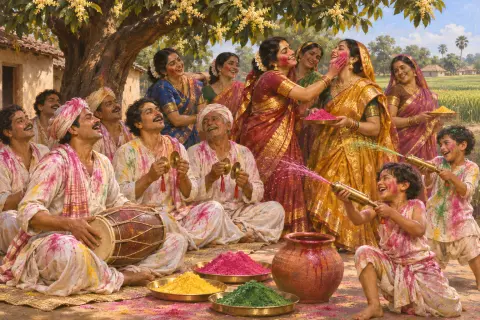 HoliMar 21 - Mar 22, 2027The Huranga after Holi is held at the Dauji temple in Baldeo near Mathura, his own temple, where he is worshipped as the elder brother.
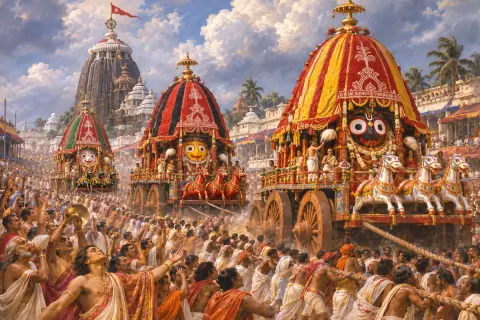 Rath YatraJul 5, 2027As Balabhadra, Jagannath's elder brother, he rides the first of the three chariots, Taladhwaja, from the temple at Puri to the Gundicha temple.
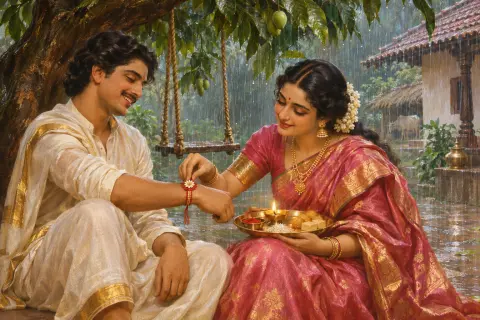 Raksha BandhanAug 17, 2027In Odisha the full moon of Shravana is Gamha Purnima, when his birth is remembered and cattle are decorated.
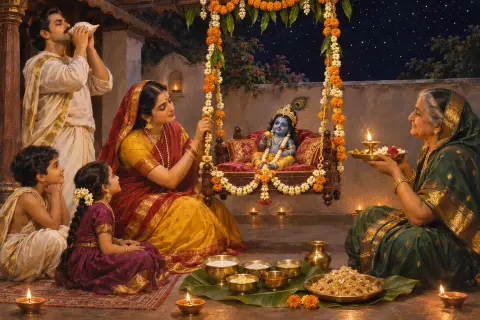 JanmashtamiAug 25, 2027He is the seventh child of Devaki, moved by Yogamaya into Rohini's womb before Krishna, the eighth, was born.
 ChaurchanSep 3, 2027In the Syamantaka story he chases Shatadhanva with Krishna, doubts his brother over the missing jewel, and stays in Mithila, where Duryodhana learns the mace from him.
Paintings
1 paintingsAsk about Balarama
Ask Gita Chat about Balarama and what their story can teach you.