The Story
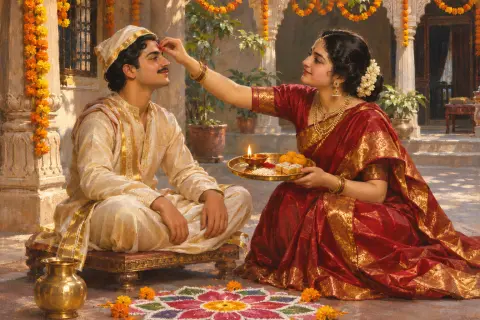
The oldest written account of Raksha Bandhan is in the Bhavishyottara Purana, the last part of the Bhavishya Purana (Uttara Parva, chapter 137). There Krishna tells Yudhishthira how, when the gods were losing their war against the asuras, Indra's wife Indrani tied a protective thread, a raksha, on Indra's wrist, and Indra won. Krishna then describes the rite: on the full moon of Shravana the royal priest should tie a raksha on the king with the mantra above, and people of every class should have one tied, for a year of safety and wellbeing. In this oldest form the raksha is a blessing thread tied by a priest or a wife. Sisters tying it on brothers, which is what most families think of today, is the later and now most loved form of the same custom.
Indrani Ties a Thread on Indra
The war between the gods and the asuras had gone on for a long time, and the gods were losing. Indra, king of the gods, had lost heart. In the retelling most families know, his teacher Brihaspati told him that strength alone would not save him and that he needed a raksha, a thread of protection, made with prayer.
On the full moon of Shravana, Indrani prepared the raksha with mantras and tied it on Indra's right wrist. Indra went back into battle with it, and this time the gods won. Krishna tells Yudhishthira the story to explain why the thread is tied on this day and how its blessing works: it is a prayer made visible, tied by someone who wishes you well.
In older practice the raksha was not a shop-bought rakhi but a small bundle of rice grains and mustard seeds wrapped in silk or cotton and tied with a coloured thread. In many parts of north India, including Bihar, family priests still go from house to house on this day, tie a simple raksha on everyone's wrist with the mantra "yena baddho bali raja", and receive a small gift.
Bali, Vamana and Lakshmi
The mantra names Bali, king of the danavas. His story is told in the Bhagavata Purana (Book 8, chapters 18 to 23). Bali was generous and powerful and had taken all three worlds. Vishnu came to him as Vamana, a small brahmin boy, and asked for just three steps of land. Bali agreed. Vamana grew until two steps covered the earth and the sky, and Bali offered his own head for the third. Vishnu sent him to rule Sutala, a world below, and promised to stay close to him and protect him there. Bali, bound by his own word, is the king the mantra remembers.
A popular tradition, not found in the Bhagavata, carries the story further. With Vishnu staying at Bali's side, Lakshmi missed her husband. On the full moon of Shravana she came to Bali as a woman with no family, tied a thread on his wrist and called him her brother. Bali asked what gift she wanted, and she asked for her husband to come home. Bali kept his word and let Vishnu go. Many families tell this story to explain why a sister ties the thread and the brother offers whatever she asks.
In Kerala the same Bali, called Mahabali, is the king whose yearly visit is celebrated at Onam. The Raksha Bandhan mantra remembers a different side of him: a king who kept his promise even when it cost him everything.
Draupadi and Krishna's Cut Finger
The story most children hear about Rakhi today is about Draupadi and Krishna. Krishna cut his finger, in many tellings while releasing his discus to kill Shishupala, and it began to bleed. Draupadi at once tore a strip from the edge of her sari and tied it round his finger. Krishna promised to repay that strip of cloth, and he did when Draupadi was dragged into the Kaurava court and they tried to strip her: her sari kept growing and could not be pulled away.
This is a folk story. The Mahabharata tells of Shishupala's death and of the attempt to disrobe Draupadi, both in the Sabha Parva, but neither the cut finger nor the strip of cloth appears there. It is still worth telling for what it says: a small kindness, done without thinking, can be remembered and returned many times over.
Karnavati, Humayun and Tagore's Rakhi
A well known story says that Rani Karnavati of Mewar, ruling at Chittor for her young son, sent a rakhi to the Mughal emperor Humayun when Sultan Bahadur Shah of Gujarat besieged the fort in 1535, and that Humayun set out to help her but arrived too late. The siege and the jauhar of the women of Chittor are recorded history. The rakhi is not. No account written at the time mentions it; the story is best known from James Tod's Annals and Antiquities of Rajasthan, written three centuries later, and many historians doubt it happened.
There is a later rakhi that is well recorded. When Bengal was partitioned in 1905, Rabindranath Tagore called on Hindus and Muslims to tie rakhis on one another's wrists as a sign that the people of Bengal could not be divided. Crowds in Calcutta did just that, and he wrote songs for the day. It showed that a rakhi can be a promise between neighbours, not only between brother and sister.
One Full Moon, Many Festivals
The same full moon is Shravani Upakarma, when many brahmin men, especially followers of the Yajurveda, bathe, renew their sacred thread (janeu) and begin the year's Vedic study again. In Tamil Nadu and Kerala this is Avani Avittam. In Nepal the day is Janai Purnima: men change their janai, priests tie a yellow or red raksha thread (doro) on the wrists of everyone who comes, Newar families eat kwati, a soup of many sprouted beans, and pilgrims go to the lake of Gosaikunda and to Kumbheshwar temple in Patan.
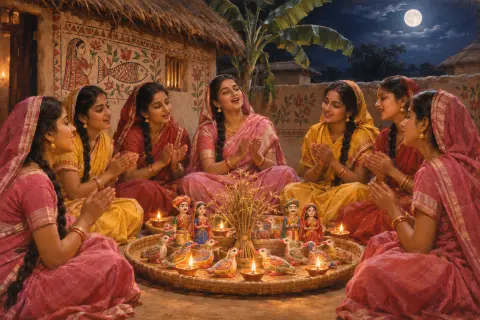
On the Maharashtra and Konkan coast it is Narali Purnima. Koli fishing families offer coconuts to the sea as the monsoon calms down, ask it to be kind, and begin the new fishing season; at home they make narali bhat, sweet coconut rice. In parts of Madhya Pradesh, Chhattisgarh and Uttar Pradesh it is Kajari Purnima: on Kajari Navami women, especially mothers of sons, sow barley in leaf cups filled with earth from the fields, keep them in a dark room, and on the full moon carry the green shoots in procession to a pond or river. In Odisha the day is Gamha Purnima, when cattle are decorated and Balarama's birth is remembered, and in Bengal it closes Jhulan Yatra, the swing festival of Radha and Krishna.
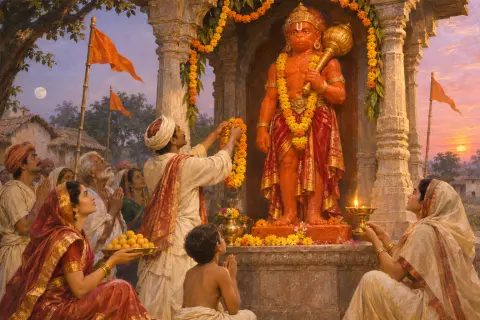
In Bihar Raksha Bandhan is kept in almost every home. Sisters fast until they have tied the rakhi, married daughters come back to their parents' house or send rakhis by post, and the family priest makes his rounds with the raksha mantra. The full moon also closes the month of Shravan, the season of the Shravani Mela, when kanwariyas in saffron collect Ganga water at Sultanganj in Bhagalpur district and walk with it, many barefoot, more than a hundred kilometres to offer it to Baba Baidyanath at Deoghar. In Bhojpur and the villages of eastern Uttar Pradesh this is also the season of kajari, the rain songs women sing on swings in Sawan, and rakhi day comes at the end of that singing month.
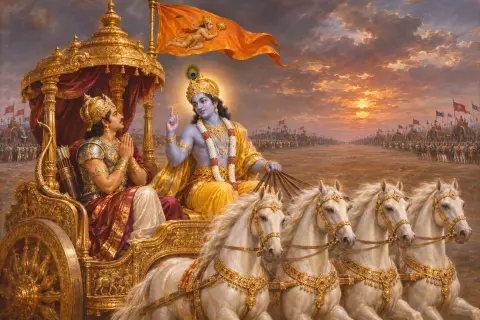
Indrani tied the thread so that Indra would not fight alone, and a sister ties it today so her brother remembers that someone is praying for him. In Gita 18.66 Krishna ends his teaching with a promise: take refuge in me, "I will free you from all sins, do not grieve." A rakhi is a small human version of that promise. It says: I am with you, and you do not have to be afraid.