Ganga is the river Ganges worshipped as a goddess, Ganga Maiya, mother Ganga. The Rigveda names her in its hymn to the rivers. The Ramayana tells how King Bhagiratha brought her down from heaven to free the souls of his ancestors, and how Shiva caught her in his matted hair so her fall would not break the earth. In the Mahabharata she is the wife of King Shantanu and the mother of Bhishma. In the Gita Krishna says, "Among rivers I am the Ganga." People bathe in her on Kartik Purnima, Makar Sankranti and Ganga Dussehra, carry her water to Shiva in Shravan, and take it home for every rite from birth to death.
Also called: Ganga Maiya (mother Ganga), Bhagirathi (brought down by Bhagiratha), Jahnavi (daughter of the sage Jahnu), Tripathaga (who flows on three paths: heaven, earth and the underworld), Mandakini (her name in heaven), Vishnupadi (who flows from Vishnu's foot), Surasari and Devanadi (river of the gods), Gangeya is a name of her sons, Bhishma and Skanda
Parents: Himavan, king of the mountains, and his queen Mena (Ramayana, Bala Kanda). The Puranas say she flows from Vishnu's foot.
Sister: Uma, that is Parvati, her younger sister in the Ramayana
Husband: King Shantanu of Hastinapura in the Mahabharata; in some Puranas and in folk song she is a wife of Shiva, and in the Brahma Vaivarta Purana a wife of Vishnu
Sons: Bhishma, born Devavrata, and seven elder sons who were the Vasus; she also carried the newborn Skanda, so both are called Gangeya
Mount: the makara
Home: heaven, where she is Mandakini; the earth, from Gangotri to Gangasagar; and the underworld
O Ganga, Yamuna, Sarasvati and Shutudri, with the Parushni, accept this hymn of mine. O Marudvridha with the Asikni, O Arjikiya with the Vitasta and the Sushoma, listen.
Stories
Ganga is a real river before she is a story. The Rigveda names her in its hymn to the rivers, but says little more. The Ramayana (Bala Kanda, sargas 35 and 38 to 44 in the Gita Press numbering) gives her the story everyone knows: elder daughter of the Himalaya, brought down by Bhagiratha, caught by Shiva and swallowed by the sage Jahnu. The Mahabharata (Adi Parva) makes her Shantanu's wife and Bhishma's mother; section numbers below for it follow K. M. Ganguli's translation. The Puranas add that she began as water washing Vishnu's foot. Through all of this she is two things at once: a goddess with a face and feelings, and the water itself, which people still step into every morning.
A River in the Rigveda
The tenth book of the Rigveda has a hymn in praise of the rivers, the Nadistuti (10.75). Most of it sings of the Sindhu, the Indus, roaring like a bull as it runs to the sea. In its fifth verse the poet calls the rivers of north India by name, from east to west, and the first name is Ganga, then Yamuna and Sarasvati. That verse is the one at the top of this page.
This is almost all the Rigveda says about her. The Ganga plain was at the far eastern edge of the Vedic world then. As people moved east, the river moved to the centre of their lives, and by the time of the epics she had become the holiest river of all.
The Puranas later explain where her holiness comes from. When Vishnu as Vamana grew to fill the universe, his foot pierced the shell of the cosmos, and the water that washed it flowed in as the Ganga (Bhagavata Purana 5.17.1). The Bhagavata also says that Brahma washed the foot that reached his world, and that water became the Ganga (8.21.4). This is why she is called Vishnupadi.
The Elder Daughter of the Himalaya
On the way to Mithila, the sage Vishvamitra tells young Rama and Lakshmana who the Ganga is (Ramayana, Bala Kanda 35). Himavan, lord of the mountains, had two daughters by his wife Mena. The elder was Ganga and the younger was Uma. The gods asked Himavan for Ganga, for the good of the three worlds, and he gave her. She went to heaven, and that is why she flows in the sky as well as on earth.
Vishvamitra then tells a second story (Bala Kanda 37). The gods needed a commander, and Shiva's seed was too fiery for anyone to hold. Agni carried it to the Ganga, and she held it as long as she could before laying it down on the mountain. From it was born Kumara, nursed by the six Krittikas. That is why Skanda is called Gangeya too, the Ganga's son.
Sagara's Sons and Bhagiratha's Penance
King Sagara of Ayodhya, an ancestor of Rama, began a great horse sacrifice, and the horse was stolen. His sixty thousand sons dug through the earth looking for it and found it grazing near the sage Kapila. Thinking he was the thief, they rushed at him, and with one sound of his anger they were burnt to ashes (Bala Kanda 38 to 41). Only the waters of heaven, the Ganga, could purify those ashes and lift their souls.
Sagara's grandson Anshuman tried and failed, and so did Anshuman's son Dilipa. Dilipa's son Bhagiratha gave up his throne and went to Gokarna to do penance for a thousand years, arms raised, among five fires, eating once a month. Brahma was pleased and granted the boon. But the earth could not bear the Ganga's fall, Brahma said, and only Shiva could hold her (Bala Kanda 42).
The Bhagavata Purana (9.9) tells the same story with a conversation. Ganga asks Bhagiratha two things: who will hold her force, and how she will get rid of the sins that people will wash into her. Bhagiratha answers that Shiva will hold her, and that saints who bathe in her will take those sins away.
Caught in Shiva's Hair
Shiva takes the falling Ganga in his hair as Bhagiratha watches.
Bhagiratha did penance again, this time for Shiva, standing on the tip of one toe for a year, and Shiva agreed. Ganga came down in anger, meaning to sweep Shiva himself into the underworld. Shiva knew her mind. He caught her in his matted hair, and she wandered lost in its coils for many years, unable to find a way out (Bala Kanda 43).
Bhagiratha prayed once more, and Shiva let her go into the lake Bindusaras. From there she split into seven streams. Three flowed east, three flowed west, and the seventh followed Bhagiratha's chariot. The text says gods and sages came to watch, and people bathed in her and were freed of their sins.
On the way she flooded the sacrificial ground of the sage Jahnu. Angry, he drank up the whole river. The gods begged him, and he let her out again through his ears. So she became his daughter, Jahnavi. Then she followed Bhagiratha to the sea and down into the underworld, and washed over the ashes of Sagara's sons, and they rose to heaven. Brahma told Bhagiratha that the river would be called Bhagirathi, his daughter, after him (Bala Kanda 44).
Shantanu's Wife and Bhishma's Mother
The Mahabharata tells how King Mahabhisha, in Brahma's court, stared at Ganga when the wind blew her garment aside, and was told to be born on earth as Shantanu. Ganga, on her way back, met the eight Vasus, who had been cursed by the sage Vasishtha to be born as men, and promised to be their mother and to free them quickly (Adi Parva, sections 96 to 99).
She married King Shantanu on one condition: he must never question or stop her. As each son was born she threw him into the river, and seven times the king said nothing. When the eighth was born he could not bear it and cried out. Ganga told him who she was and why she had done it, and left with the child. Years later she brought back Devavrata, grown, learned in the Vedas and in weapons (sections 98 to 100). He became Bhishma.
She stays near her son to the end. When Bhishma died after his long wait on the bed of arrows, and the Kurus offered water for him at the river, Ganga rose from the stream, weeping for her son (Anushasana Parva, section 168).
Ganga at the Ghats
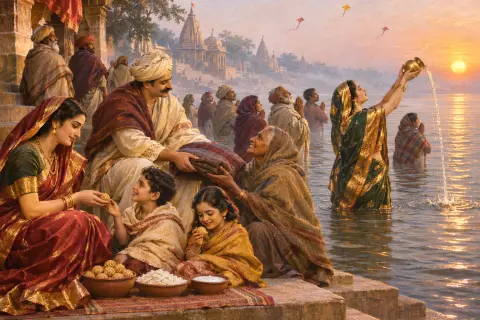
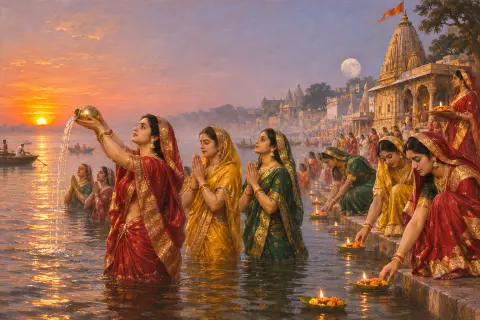
For most people the goddess is met in the water. Bathing at dawn is the heart of Kartik Purnima, which in Bihar is simply called Ganga Snan, and in Varanasi the same evening is Dev Deepawali, when the ghats are lit with lamps because the gods are believed to come down to bathe. On Makar Sankranti pilgrims crowd onto Sagar Island in Bengal, where local tradition says the Ganga met the ashes of Sagara's sons, to bathe where she meets the sea.
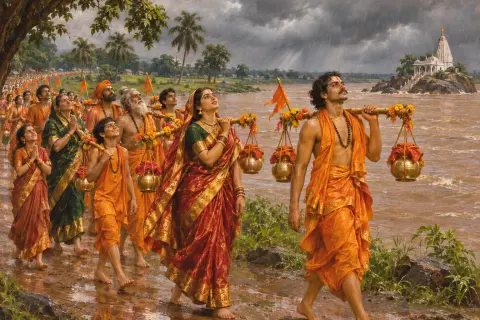
Ganga Dussehra, on the tenth day of the bright half of Jyeshtha, is kept as the day she came down to earth. The name is usually explained as dasha hara, the remover of ten sins, and families bathe and give gifts. In Shravan, kanwariyas carry Ganga water on foot to pour on Shiva, at Deoghar from Sultanganj and across north India from Haridwar.
Her water marks a whole life. A few drops are given to a newborn and to the dying, ashes are carried to her, and a sealed pot of Gangajal sits in many prayer rooms. Every evening at Har ki Pauri in Haridwar and at Dashashwamedh Ghat in Varanasi, priests wave great lamps at her in the Ganga aarti.
How to recognise
•A fair woman with two arms, often in white, standing or seated on a makara, a river creature with a crocodile's body, a curling snout and a fish's tail. The makara is her vahana in temple images and calendar art alike.
•A full water pot (purna kumbha) in one hand, the sign of the life-giving river, and often a lotus or a fly-whisk in the other.
•From the Gupta period onward she stands at temple doorways with Yamuna on the other side, Ganga on her makara and Yamuna on a tortoise, so that everyone who walks in passes between two holy rivers. The doorway of the Dashavatara temple at Deogarh is a well-known early example.
•In images of Shiva as Gangadhara, the bearer of Ganga, she is a tiny woman or a jet of water in his piled matted hair, sometimes with folded hands. Many Shiva pictures show only the stream rising from his topknot.
•In pictures of the descent, King Bhagiratha kneels below or drives his chariot ahead while the river follows him.
•At the ghats she is worshipped as the river herself: lamps floated on leaf boats, flowers, the evening aarti at Haridwar and Varanasi, and sealed pots of Gangajal kept in homes.
Among the purifiers (or the speeders) I am the wind; Rama among the warriors am I; among the fishes I am the shark; among the streams I am the Ganga.
Krishna lists his glories and says, "Among rivers I am the Jahnavi," the daughter of Jahnu. Shankara's commentary glosses the name simply as Ganga. It is the one place the Gita names her.