Sanjaya is the charioteer and minister of the blind King Dhritarashtra in the Mahabharata, the son of Gavalgana, of the suta community of charioteers and bards. Before the war the sage Vyasa gave him divine sight, and through it he saw and heard everything at Kurukshetra and told it to the king. The Bhagavad Gita reaches us in his voice: he speaks its second verse, describes Krishna and Arjuna between the armies, and closes it with the words that wherever Krishna and Arjuna are, there is fortune, victory and right conduct (18.78). He was also the king's peace envoy, the last man to speak with Duryodhana before he hid in the lake, and the one who escaped the forest fire that took the king.
Also called: Gavalgani (son of Gavalgana), Suta and Sutaputra (the charioteer, the charioteer's son), the narrator of the war books of the Mahabharata
Father: Gavalgana, a suta; community: the sutas, charioteers and bards
Master: King Dhritarashtra, whom he served as charioteer, minister and companion all his life
Gift: divine sight from Vyasa for the length of the war
By the grace of Vyasa I heard this supreme secret, this yoga, from Krishna, the lord of yoga, as he spoke it himself.
Stories
Sanjaya is the voice of a large part of the Mahabharata, traditionally credited to Vyasa. In the Udyoga Parva he goes as Dhritarashtra's envoy to the Pandavas; from the Bhishma Parva to the Sauptika Parva he tells the blind king the whole war, day by day, including the Bhagavad Gita; and in the Ashramavasika Parva he follows the king into the forest. The section numbers below follow K. M. Ganguli's English translation unless the Critical Edition prepared at Pune is named. The epic gives him a rare position: a servant of the Kaurava king who sees clearly, speaks frankly to his master, and openly admires Krishna and the Pandavas.
The envoy
When the Pandavas returned from exile and asked for their share of the kingdom, Dhritarashtra sent Sanjaya to them at Upaplavya with a message: avoid war. Sanjaya spoke to Yudhishthira of peace, and brought back the Pandavas' answer (Udyoga Parva, sections 22 to 31).
He came back at night and would not wait. In the king's chamber he told Dhritarashtra to his face that Yudhishthira was blameless, and that the king, by following his son, had earned a bad name in this world and misery in the next (section 32). That night Dhritarashtra could not sleep, and sent for Vidura.
Later he told the Kaurava court how he had found Krishna and Arjuna together in their private rooms: seated on one golden seat, Krishna's feet resting in Arjuna's lap, Arjuna's in Krishna's and Satyabhama's. Seeing those two dark young heroes side by side, he said, he was seized with fear: they looked to him like Indra and Vishnu together, and he knew then what the war would bring (section 59).
The gift of sight
Just before the battle Vyasa came to Dhritarashtra and offered him sight to watch it. The king refused; he did not want to see his family killed. So Vyasa turned to Sanjaya: he will see everything that happens in the battle, in public or in secret, by day or by night, even what men only think; weapons will not cut him and he will not tire; he will tell you all of it (Bhishma Parva, section 2).
The epic then does something unusual. On the tenth day Sanjaya rushes in from the field and tells the king that Bhishma has fallen. Dhritarashtra asks how, and Sanjaya tells the war from its first morning (sections 13 and 14). So the Bhagavad Gita, spoken on that first morning, is told in flashback, by a man who already knows how it ended.
The voice of the Gita
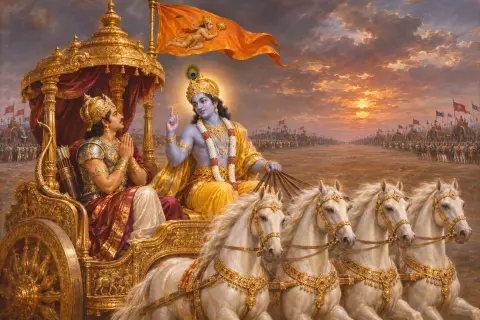
Dhritarashtra speaks only the first verse of the Gita. Everything after it is Sanjaya's report: Duryodhana going up to Drona (1.2), the conches, Krishna placing the chariot between the armies (1.24), Arjuna sinking down with his bow dropped (1.47), and Krishna smiling as he begins to teach (2.10). In chapter 11 he describes the universal form as Arjuna saw it.
At the very end he speaks for himself. He says that by Vyasa's grace he heard this supreme yoga from Krishna himself (18.75), that he rejoices again and again remembering it (18.76 and 18.77), and that wherever Krishna and Arjuna are, there will be fortune, victory and right conduct; that is his conviction (18.78). He says this to the father of the army that is about to lose.
The last meeting with Duryodhana
Sanjaya meets Duryodhana alone on the last evening of the war.
On the eighteenth day Sanjaya was on the field himself and was captured. Dhrishtadyumna said there was no point keeping him alive, and Satyaki raised his sword. At that moment Vyasa appeared and said: let Sanjaya go. Satyaki set him free (Shalya Parva, section 29).
Sanjaya put down his armour and walked toward the city in the evening. About two miles on he found Duryodhana standing alone with his mace, badly wounded, his eyes so full of tears that at first he did not recognise him. Sanjaya told him that all his brothers and his army were dead. Duryodhana touched him with his hand and said: of all who fought on my side, only you are alive. Tell my blind father that his son has entered the lake. Then he went into the water. That was the last Sanjaya saw of him before the duel.
After Duryodhana died, Sanjaya told the king, the divine sight Vyasa had given him left him (Sauptika Parva, section 9).
The guide in the forest
When Dhritarashtra, Gandhari and Kunti went to live in the forest, Sanjaya went with them (Ashramavasika Parva, section 16). When the Pandavas and their wives visited, it was Sanjaya who pointed each of them out to the forest ascetics, describing their faces and complexions (section 25).
He guided the old king over rough and even ground. When the forest fire came, Dhritarashtra told him to go and save himself. Sanjaya said a death by an unsanctified fire was a misfortune, but he could see no way out. The king said they had left home by their own choice and such a death was fit for ascetics. Sanjaya walked around him in reverence, told him to fix his mind, and left. Narada later saw him on the bank of the Ganga among ascetics, from where he set out for the Himalayas (section 37). The epic says no more of him.
How to recognise
•Seated beside the blind Dhritarashtra in the palace at Hastinapura, describing what he sees far away: the frame of the Gita, painted on the opening page of many printed editions.
•A man of plain dress, a charioteer and counsellor rather than a prince, usually shown without crown or weapons, with his eyes looking into the distance.
•As the peace envoy, seated on the floor before Krishna and Arjuna after touching the golden footstool Arjuna offered him: his own account of his visit in the Udyoga Parva (section 59).
•In the forest years later, walking ahead of the blind king and the two queens as their guide, until the fire.
Sanjaya said: Having seen the army of the Pandavas drawn up in battle-array, King Duryodhana then approached his teacher (Drona) and spoke these words.
The first words in Sanjaya's voice: having seen the Pandava army in battle order, King Duryodhana went up to his teacher Drona.
Sanjaya said: Having thus spoken in the midst of the battlefield, Arjuna, casting away his bow and arrow, sat down on the seat of the chariot with his mind overwhelmed with sorrow.
Sanjaya ends the first chapter: Arjuna, having spoken, cast away his bow and arrows and sank down in the chariot, his mind overwhelmed by grief.
Sanjaya said: Having spoken thus to Hrishikesha (the Lord of the senses), Arjuna (the conqueror of sleep), the destroyer of foes, said to Krishna, "I will not fight" and became silent.
Sanjaya reports Arjuna's flat refusal, I will not fight, and his silence.
Sanjaya said: Thus I have heard this wonderful dialogue between Krishna and the high-souled Arjuna, which causes the hair to stand on end.
Sanjaya begins his closing words: this is the wonderful dialogue of Krishna and the great-souled Arjuna that I heard, which makes the hair stand on end.
Wherever is Krishna, the Lord of Yoga; wherever is Arjuna, the wielder of the bow; there are prosperity, victory, happiness and firm policy; such is my conviction.
The last verse of the Gita, and Sanjaya's own conviction: where Krishna and Arjuna the archer are, there are fortune, victory, prosperity and right conduct.