The Story
Vijayadashami means "the tenth day of victory". The stories people tell about it are older than the festival's link to them. The Devi Mahatmya of the Markandeya Purana (chapters 81 to 93) tells how Durga killed Mahishasura, and Shakta tradition keeps this tenth day as the day of her victory. Valmiki's Ramayana tells how Rama killed Ravana in the Yuddha Kanda, but it does not say this happened on Ashvin Shukla Dashami. The link between Ravana's death and Dussehra comes from later tradition, the Ramlila stage, and regional retellings. The Mahabharata's Virata Parva tells how the Pandavas hid their weapons in a shami tree, which is why the shami is worshipped today. Kings once marked the day by worshipping their weapons and setting out on campaigns, and that is the older layer under the festival.
Rama and Ravana
In the Yuddha Kanda of Valmiki's Ramayana, Rama crosses to Lanka with the army of Sugriva to win back Sita, whom Ravana had carried off. After many days of war, in which Kumbhakarna and Meghnad (Indrajit) are killed, Rama and Ravana fight face to face. The sage Agastya comes to the tired Rama and teaches him the Aditya Hridayam, a hymn to the sun. Indra sends his own chariot with his charioteer Matali. Rama cuts off Ravana's heads again and again, and they grow back, until he uses the Brahmastra, the weapon Agastya had given him, and strikes Ravana in the chest.
Valmiki gives no calendar date for this. Other texts tied the war to the autumn worship of the goddess. The Devi Bhagavata Purana (Book 3, chapter 30) says Rama kept the Navaratri vow on the advice of Narada before the war. The Bengali Ramayana of Krittivas, from the fifteenth century, tells how Rama worshipped Durga in autumn, out of the usual season, to win her blessing, a story called akal bodhan. Over time, many people came to believe that Ravana was killed on the tenth day, and in many places that Rama set out for Lanka on this day.
What reached most north Indian homes was the Ramcharitmanas of Tulsidas, written in Awadhi in the sixteenth century. Ramlila, the yearly staging of Rama's story, follows the Manas, and its calendar ends the war on Dussehra night. So when people say Rama defeated Ravana on Dussehra, they are speaking from this living tradition, not from Valmiki's text.
Ramlila and Ravana Dahan
In the weeks of Navaratri, towns and neighbourhoods across north India stage Ramlila, usually one episode a night. On Dussehra evening huge effigies of Ravana, his brother Kumbhakarna and his son Meghnad, made of bamboo and paper and filled with firecrackers, are set alight by an actor playing Rama, who shoots a burning arrow. In Delhi the biggest burnings are at Ramlila Maidan and the grounds near the Red Fort. UNESCO lists the Ramlila of north India as intangible cultural heritage.
The Ramlila of Ramnagar, across the Ganga from Varanasi, is different. It was begun under the Maharajas of Kashi about two centuries ago and runs for about a month. Instead of one stage, the whole town becomes the set: one place is Ayodhya, another Panchavati, another Lanka, and the audience walks from place to place with the actors. There are no microphones, and the Maharaja of Kashi still attends on many nights.
In Bihar, the largest Ravana Dahan is in Patna, where the Ravan Vadh at Gandhi Maidan has drawn huge crowds since the 1950s, with effigies of Ravana, Kumbhakarna and Meghnad. Across Bihar the same evening is also the farewell of Durga: after Navami, the pandal images are taken in procession, with drums and songs, to the Ganga and other rivers and ponds for immersion, and married women first fill the goddess's lap, the khoinchha, as they would for a daughter leaving home. The barley shoots from the Navaratri kalash, called jayanti, are offered and then placed by elders on the heads or behind the ears of the family as a blessing.
Durga's Victory: Bengal and Mysuru
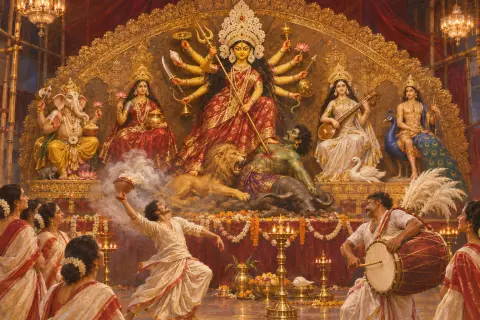
For Shakta tradition, Dashami is the day Durga's work is done. In Bengal it is Bijoya Dashami, the last day of Durga Puja, which has its own page on this site. Married women do Debi Boron, offering sindoor, sweets and betel to the goddess as a goodbye, and then smear sindoor on each other's faces in sindoor khela. The images are carried to the river and immersed, and people go home to touch the feet of elders, hug friends and share sweets, saying "Shubho Bijoya".
In Mysuru, Dasara is Karnataka's state festival, and the Wadiyar kings have held it in the city since the early 1600s, carrying on the Mahanavami festival of the Vijayanagara kings. The goddess here is Chamundeshwari of Chamundi Hill, the form of Durga who killed Mahishasura, the demon from whom the city's name is said to come. On Vijayadashami the Jamboo Savari procession leaves the palace: her image rides on the lead elephant in a golden howdah of about 750 kilograms, and the procession goes through the city to Bannimantap.
Banni is the Kannada name of the shami tree, and at Bannimantap the shami is worshipped, just as the old kings did before setting out. The day ends there with a torchlight parade. In the days of the kings the Maharaja himself rode in the howdah; today the goddess rides in his place.
The Shami Tree and Arjuna's Bow
The Virata Parva of the Mahabharata tells of the thirteenth year of the Pandavas' exile, which they had to spend in disguise. Before entering King Virata's city, they wrapped their bows and swords and hid them high in a large shami tree near a cremation ground (chapter 5). They hung a corpse from the tree too, so that people would keep away.
At the end of the year the Kauravas raided Virata's cattle. Arjuna, disguised as the dance teacher Brihannala, drove the chariot of the young prince Uttara out to meet them. At the shami tree he told Uttara to climb up and bring down the bundles. Uttara was afraid of touching a corpse, but Arjuna told him there were only bows there. Uttara climbed up and found Arjuna's bow Gandiva and the other Pandavas' weapons, and Arjuna went on to drive back the whole Kaurava army.
The text does not date this to Vijayadashami, but tradition does, and so the shami is worshipped on this day. In Maharashtra and Karnataka people go to a shami tree, and in Maharashtra also to an apta tree, after Aparajita puja, crossing the edge of the village or town (simollanghan), and then give each other the leaves as "gold". In Karnataka, Kerala, Tamil Nadu and Andhra Pradesh, tools, books, vehicles and weapons are cleaned and worshipped as Ayudha Puja, and in Kerala young children are taught to write their first letters on Vijayadashami, called Vidyarambham.
Kullu, Bastar and Nepal: The Day Kept Differently
In Kullu, Himachal Pradesh, Dussehra starts on Vijayadashami, just as it ends elsewhere, and lasts seven days. Its centre is Raghunath, an image of Rama brought from Ayodhya in the seventeenth century under Raja Jagat Singh, who then ruled in Raghunath's name. Village deities from all over the valley are carried down in palanquins to Dhalpur ground to meet him, and Raghunath's chariot is pulled through the crowds. No Ravana effigy is burned. On the last day a symbolic burning of Lanka is held near the Beas river.
In Bastar, Chhattisgarh, Dussehra lasts about seventy five days, from the dark moon of Shravan to the bright half of Ashvin. It honours the local goddess Danteshwari, not Rama, and was begun by the Kakatiya kings of Bastar; tradition credits Raja Purushottam Dev, whose dates are given differently by different sources. Tribal communities build a huge wooden chariot and pull it through Jagdalpur, and different communities have their own set roles in its rituals.
In Nepal, Bada Dashain is the biggest festival of the year, and Vijaya Dashami is its main day. Elders put a red tika of rice, curd and vermilion on the foreheads of younger relatives and give them the yellow barley shoots, jamara, grown since the first day of Navaratri, along with blessings and a little money. Families travel to visit every elder they can, and the tika visits go on until the full moon, Kojagrat Purnima.
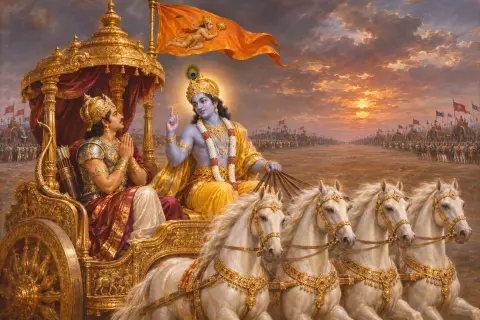
At the very end of the Gita (18.78), Sanjaya says that wherever there is Krishna, the lord of yoga, and Arjuna, the archer, there will be fortune, victory and right conduct. Ravana had strength and learning, but no restraint, and Mahishasura had power but used it only for himself. Dussehra celebrates victory, and the Gita's verse says what makes a victory last: skill and effort guided by what is right.