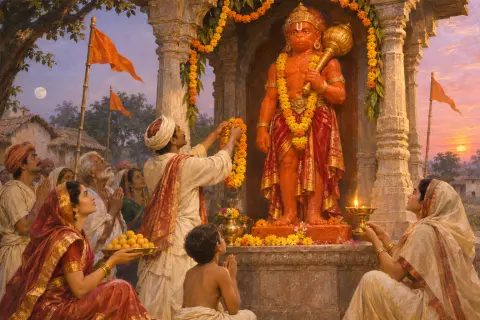
Vayu is the god of the wind and of breath. In the Rigveda he is a swift god who drives a chariot with Indra and drinks the first share of soma; in the Upanishads he becomes prana, the breath that keeps every body alive, and the Taittiriya Upanishad calls him Brahman that can be seen and felt. In the epics he is the divine father of the two strongest heroes, Hanuman in the Ramayana and Bhima in the Mahabharata. He is honoured as their father on Hanuman Jayanti, and the Madhva tradition of Karnataka sees its founder as his third coming.
Also called: Vata (the wind), Pavana (the purifier), Marut and Maruta (wind), Anila, Samirana, Prana (breath), Matarishvan, Gandhavaha (carrier of scents), Sadagati (always moving), Mukhyaprana (the chief breath, in the Madhva tradition)
Origin: born from the breath of the cosmic Person in the Purusha Sukta (Rigveda 10.90.13); other texts give other parents
Rigveda: called the son in law of Tvashtar (8.26.21)
Sons: Hanuman, born to Anjana by his blessing (Valmiki Ramayana), and Bhima, born to Kunti (Mahabharata)
Companions: Indra, with whom he shares a chariot and the soma in the Rigveda; the Maruts, the storm gods
Mount: an antelope or deer; in the Rigveda a chariot with a team of horses
namo brahmaṇe, namas te vāyo, tvam eva pratyakṣaṃ brahmāsi,
tvam eva pratyakṣaṃ brahma vadiṣyāmi.
Salutation to Brahman. Salutation to you, Vayu. You alone are Brahman that can be perceived. You alone I will call the perceptible Brahman.
Stories
Vayu is one of the gods of the Vedic sky. The Rigveda praises him and Vata, the roaring wind, in a few hymns of their own and in many shared with Indra. The Upanishads turn him inward: the wind outside is the breath inside, prana, which is greater than the eye, the ear or speech. In the Ramayana and Mahabharata he steps into the human story as the father of the two strongest heroes, Hanuman and Bhima, and his love for his sons shows in what he does when Hanuman is hurt. Later South Indian traditions add contests of strength, and the Madhva school makes him the chief of all souls after Vishnu.
The First to Drink the Soma
The second hymn of the Rigveda begins with Vayu: "Come, Vayu, lovely one, these soma drinks are ready." Another hymn (4.46) asks him to drink first of the sweet juices, and the priests explain that the first draught of soma belongs to him. He arrives quickly, on a shining chariot pulled by a team of horses, and often shares it with Indra. The pair Indra and Vayu are praised together in many hymns.
In the Purusha Sukta (Rigveda 10.90.13), where the world is made from a cosmic Person, Vayu is born from his breath. And a short hymn to Vata (10.168) describes the roaring storm wind that no one sees: "His sound is heard, but his form is not seen. Let us worship this Vata with an offering." It calls him the breath of the gods and the seed of the world.
Breath, the Greatest of the Senses
The Upanishads take the wind inside the body. In the Chandogya Upanishad (5.1), the senses argue about which of them is greatest. Speech leaves the body for a year, and the body lives on, mute. Then the eye leaves, then the ear, then the mind, and each time the body lives on. When breath begins to leave, all the others are torn up with it, like pegs pulled out by a horse. They bow and admit that breath is the greatest. The Brihadaranyaka Upanishad (1.3) tells a similar story: the asuras spoil speech, smell, sight and hearing with evil, but when they attack breath, they are shattered like clay against a rock.
In the Kena Upanishad (part 3), Vayu is humbled. A mysterious being puts a blade of grass before him and tells him to blow it away. Vayu, who boasts he can carry off anything on earth, cannot move it, and goes back to the gods without an answer (the Parvati page tells the rest). And the Taittiriya Upanishad opens with the prayer at the top of this page, saluting Vayu as Brahman that can be perceived: the one god you feel on your skin and in your chest every moment.
Father of Hanuman
Vayu holds the injured child Hanuman, and Brahma comes to heal him.
In the Valmiki Ramayana (Kishkindha Kanda, sarga 66), Jambavan tells Hanuman the story of his birth. His mother Anjana, once an apsara, was walking on a mountain top in human form when Vayu saw her and loved her. He told her not to fear: he had touched her only in his mind, and she would have a son as strong and wise as he, equal to the wind in leaping. That son was Hanuman, called Maruti and Pavanputra, son of the wind.
When the child Hanuman leapt at the rising sun, taking it for a fruit, Indra struck him with the thunderbolt and he fell, his jaw broken. The Uttara Kanda (sargas 35 and 36) tells what Vayu did next. In grief and anger he carried his son into a cave and stopped moving. With no wind in the three worlds, no creature could breathe; their bodies stiffened like wood.
The gods ran to Brahma, and Brahma came with them to the cave. He touched the child, and Hanuman revived. Then Vayu moved again and the worlds breathed. Brahma gave the boy the boon that no weapon would kill him, Indra that he could choose the time of his death, and the other gods gave their own gifts (the Hanuman page and the Hanuman Jayanti page tell more).
Father of Bhima
In the Mahabharata (Adi Parva), King Pandu could not father children, and Kunti used the mantra the sage Durvasa had given her. After Yudhishthira was born from Dharma, Pandu asked for a son of great strength, and Kunti called Vayu. Bhima was born, and a voice from the sky said he would be the strongest of the strong. When he was still a baby, he fell from Kunti's lap onto a rock, and the rock broke into pieces while the child was unhurt.
Bhima has the wind's strength and its appetite. He is called Vrikodara, wolf bellied, and he is the one who carries his mother and brothers when they flee the burning house of lac. In the Vana Parva, Draupadi finds a lovely saugandhika lotus carried by the wind and asks for more. Bhima sets off to find them and is stopped on a mountain path by an old monkey lying across the way, whose tail he cannot lift. The monkey is Hanuman, his elder brother, another son of Vayu (the Hanuman page tells this meeting).
Later Traditions: the Mountain Peak and Mukhyaprana
South Indian temple traditions tell of a contest between Vayu and Adishesha, the great serpent. Shesha wrapped himself round a peak of Mount Meru, and Vayu blew with all his strength to tear it away. In the Tirumala telling, the peak that flew off landed in the south and became the Venkata hills. These are later local traditions, not stories from the epics or the main Puranas, and the details vary from place to place.
In the thirteenth century, the Karnataka philosopher Madhvacharya taught a Vedanta in which Vayu holds a special place. His followers call Vayu Mukhyaprana, the chief breath, ranked with Brahma as the highest of souls after Vishnu and Lakshmi. They hold that he came to earth three times: as Hanuman in the Ramayana, as Bhima in the Mahabharata, and as Madhvacharya himself. This is why Madhva temples have a Mukhyaprana shrine, usually with an image of Hanuman.
How to recognise
•A slim, light, moving figure, often with flowing hair and clothes blown by the wind. Image texts give him a dark or smoke coloured body, like a rain cloud.
•His mount is an antelope or deer, the fastest of animals. In the Rigveda he drives a shining chariot pulled by a team of horses, often sharing it with Indra.
•He holds a banner or flag (dhvaja) that streams in the wind. The flag shows the wind itself, since it cannot be seen any other way.
•In the Devi Mahatmya (chapter 2) he gives the Goddess a bow and arrows.
•On temple walls he guards the north west as one of the eight dikpalas, the guardians of the directions.
•In Madhva temples in Karnataka he is worshipped as Mukhyaprana, usually in the form of Hanuman, since Madhvas see Hanuman, Bhima and Madhvacharya as his three comings.
Thou art Vayu, Yama, Agni, Varuna, the moon, the Creator, and the great-grandfather. Salutations, salutations unto Thee, a thousand times, and again salutations, salutations unto Thee.
Arjuna, after seeing the cosmic form, begins his praise with "You are Vayu, Yama, Agni, Varuna and the Moon." Vayu is the first god he names.