The Story
The oldest text behind Navaratri is the Devi Mahatmya, thirteen chapters of the Markandeya Purana (chapters 81 to 93), also called the Durga Saptashati or Chandi Path because it has about seven hundred verses. It tells three stories in which the goddess defeats demons the gods could not, and in chapter 12 she says that whoever listens to this account with devotion at the great yearly worship held in autumn will be freed from trouble. That autumn worship is Sharad Navaratri. The Devi Mahatmya does not lay down a nine night ritual itself. The rules of the Navaratri vow, including the worship of young girls, come from later texts such as the Devi Bhagavata Purana (Book 3, chapters 26 and 27). Reading the Saptashati during these nine nights is still the heart of the festival in many homes.
The First Story: Madhu and Kaitabha
The Devi Mahatmya is told as a conversation. A king named Suratha has lost his kingdom, and a merchant named Samadhi has been thrown out by his own family. They meet in the forest hermitage of the sage Medhas and ask him why their minds still cling to what has hurt them. Medhas answers that this is the work of Mahamaya, the goddess, and tells them three stories about her.
In the first story (chapter 1), the universe has dissolved into water and Vishnu lies asleep on the serpent Shesha. Two demons, Madhu and Kaitabha, are born from the wax of his ears and set out to kill Brahma, who sits on the lotus growing from Vishnu's navel. Brahma cannot wake Vishnu, so he praises the goddess who holds Vishnu in sleep, Yoganidra. She leaves Vishnu's eyes, mouth and heart, and he wakes.
Vishnu fights the two demons for five thousand years. The goddess clouds their minds, and in their pride they offer Vishnu a boon. He asks that they die by his hand. Trapped, they ask to be killed where there is no water, so he lays them on his thighs and kills them there. The point of the story is that even Vishnu acts only when the goddess releases him.
Mahishasura and the Goddess Made of Light
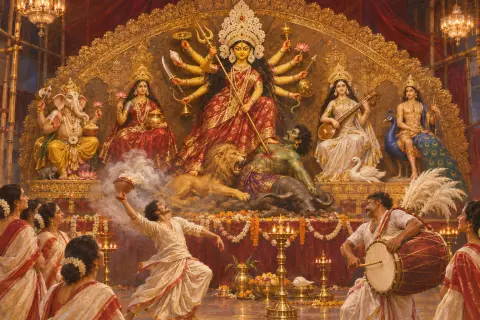
The second story (chapters 2 to 4) is the one most people know. The buffalo demon Mahishasura defeats the gods and drives Indra from heaven. The gods go to Vishnu and Shiva, and as they describe what has happened, a great light pours out of the faces of Vishnu, Shiva, Brahma and all the other gods. The light gathers into one shape and becomes a woman.
Each god gives her a weapon. Shiva gives a trident, Vishnu a discus, Varuna a conch and a noose, Agni a spear, Vayu a bow and arrows, Indra his thunderbolt and a bell, Yama his staff, and Brahma a rosary and a water pot. Himavan, the mountain king, gives her a lion to ride. She laughs aloud, and the sound shakes the worlds.
Mahishasura sends his generals and then comes himself. During the fight he changes shape again and again: a buffalo, a lion, a man with a sword, an elephant, then a buffalo once more. The goddess drinks from her cup, laughs, and tells him to roar while he can. She presses him down with her foot and strikes him with her trident, and as he struggles half way out of the buffalo's mouth in his own form, she cuts off his head. In chapter 4 the gods praise her, and she promises to come back whenever they remember her in trouble. The text does not say how many days the battle lasted. The idea that each night of Navaratri matches a day of the fight is a later popular belief.
Shumbha, Nishumbha and the Goddess Who Stood Alone
The third story (chapters 5 to 13) begins with the brothers Shumbha and Nishumbha taking over heaven. The gods go to the Himalayas and sing a hymn that salutes the goddess who lives in all beings as consciousness, memory, intelligence, patience, faith, mother and many other forms, each line ending with namastasyai, "salutations to her". Parvati comes by to bathe in the Ganga, and from her body a radiant goddess, Ambika, steps out.
Shumbha hears of her beauty and sends a proposal. She replies that she once made a promise in her foolishness: she will marry only the one who defeats her in battle. The demons come for her one after another. Dhumralochana is burned to ash by the sound of her voice. When Chanda and Munda arrive, a dark goddess, Kali, springs from her forehead and kills them, and is named Chamunda. When Raktabija fights, every drop of his blood that touches the ground becomes a new demon, so Kali drinks the blood before it falls.
After Nishumbha is killed, Shumbha mocks her for relying on the strength of others. She draws all the goddesses who have fought beside her back into her own body and says: "I am alone here in the world. Who else is there besides me?" Then she kills him. In chapter 11 the gods praise her with the hymn to Narayani that contains the verse at the top of this page. In the last chapters Suratha and Samadhi worship her for three years; the king gets back his kingdom and the merchant gains wisdom.
Ghatasthapana, the Nine Forms and Kanya Puja
Navaratri starts with Ghatasthapana, also called kalash sthapana. On the first morning a pot of water is set up with mango leaves and a coconut, and barley is sown in soil beside it or in a small bed under it. The pot is worshipped as the goddess for all nine days, a lamp is often kept burning, and the barley sprouts that grow by the tenth day are treated as her blessing.
In north India each day is given to one of the nine forms of Durga, the Navadurga. The list comes from the Devi Kavacha, the protective hymn recited before the Durga Saptashati, where Brahma names them for the sage Markandeya: Shailaputri, Brahmacharini, Chandraghanta, Kushmanda, Skandamata, Katyayani, Kalaratri, Mahagauri and Siddhidatri. The idea of wearing a different colour each day is a much newer custom. In much of south India the nine nights are often split into three groups, for Durga, Lakshmi and Saraswati.
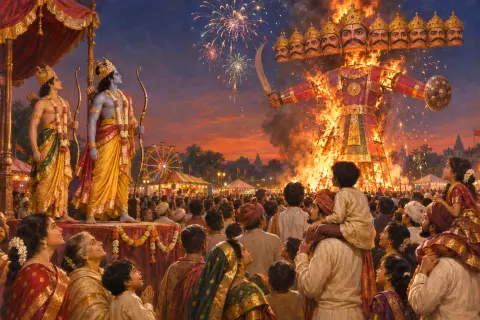
On Ashtami or Navami many families do Kanya Puja (also called Kumari Puja or kanjak). Young girls, usually nine, are invited home, their feet are washed, a red thread is tied, and they are fed puri, black chana and halwa and given small gifts, often along with one little boy who stands for Bhairava. The Devi Bhagavata Purana describes this worship of young girls during Navaratri and even gives names for them by age. The same Purana (Book 3, chapter 30) says that Rama kept the Navaratri vow on the advice of the sage Narada before going to war with Ravana.
Bihar: Kalash, Saptashati and the Pandals of Patna
In Bihar, across Magadh, Bhojpur, Mithila and Anga, Navaratri is one of the biggest festivals of the year. In homes it begins with kalash sthapana and barley sown beside the pot. Many people read the full Durga Saptashati every day or have a priest recite it, and many keep a fast for all nine days, eating fruit or one simple meal. In the evenings women sing devi geet, songs to the goddess, in Bhojpuri, Maithili and Magahi.
Public worship centres on clay images of Durga in pandals and old Durga temples. On Shashthi evening the goddess is invited at a bel tree, and on Saptami the image is consecrated and its doors, the pat, are opened for darshan. From then until Navami the crowds grow each night. In Patna, the pandals at Dak Bungalow crossing and in the old city draw huge crowds, and the Patan Devi temples, counted among the Shakti Peethas, are full through the nine days.
Many families do kanya puja on Ashtami or Navami, and the fast is broken after it. On the tenth day the barley sprouts from the kalash, called jayanti, are offered to the goddess and then placed by elders on the heads or behind the ears of the family as a blessing. Before the image leaves, married women fill the goddess's lap, the khoinchha, with rice, turmeric, durva grass, sindoor and sweets, as they would for a daughter going back to her in-laws, and then the images are taken in procession for immersion.
Garba, Golu, Mysuru and Dashain
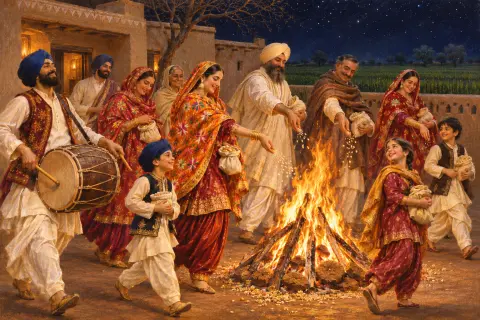
In Gujarat the nine nights are garba nights. People dance in circles around the garbo, a clay pot pierced with holes with a lamp inside, which stands for the goddess and for the womb (garbha) of life. Women wear chaniya choli and men wear kediyu, and songs to Amba and Bahuchara Mata go on late into the night. Dandiya raas, danced with pairs of painted sticks, follows in many places. In Bengal, Assam, Odisha and Tripura the last five days are Durga Puja, from Shashthi to Dashami, and that celebration has its own page on this site.
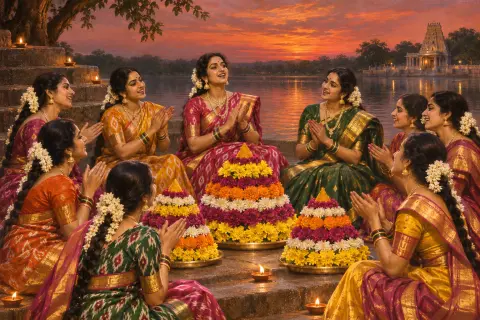
In Tamil Nadu, Karnataka and Andhra Pradesh families set up Golu (Bommai Kolu, Gombe Habba, Bommala Koluvu): steps, usually an odd number, covered with cloth and lined with dolls of gods, saints and village life. Women visit each other's homes, sing, and give betel leaves, turmeric and small gifts. On Navami books are placed before Saraswati, and tools, vehicles and weapons are cleaned and worshipped as Ayudha Puja. In Telangana women make Bathukamma, stacks of flowers, during the same nine days.
In Mysuru, Navaratri is Dasara, the state festival of Karnataka. The goddess Chamundeshwari of Chamundi Hill, who is Durga as the killer of Mahishasura, is honoured, the palace is lit every night, and the royal family holds a private durbar. In Nepal the first day of Navaratri is also the first day of Dashain: barley (jamara) is sown in a dark room, the seventh day brings Fulpati, and the tenth day is the day of tika. Spring has its own Navaratri too, Chaitra Navratri, which ends on Ram Navami and has a separate page.
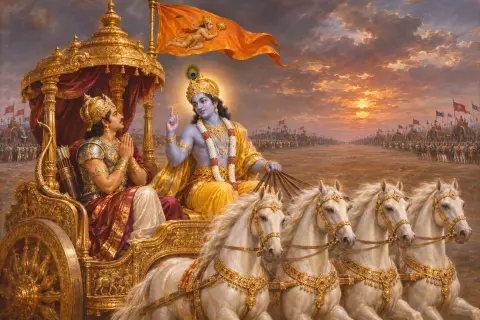
In Gita 10.34 Krishna says that among the qualities we call feminine he is fame, fortune, speech, memory, intelligence, steadiness and patience. The hymn in the Devi Mahatmya salutes the goddess living in all beings in almost the same forms: memory, intelligence, patience. Navaratri asks for nine days of attention to that power. Fasting, reading, dancing and feeding young girls are all ways of honouring it, and of noticing it in the people around us.