Indra is the king of the gods, lord of rain, storm and thunder, who rides the white elephant Airavata and carries the thunderbolt, the vajra. In the Rigveda he is the most praised god of all: about a quarter of its hymns are his, and his great deed is killing the serpent Vritra to set the waters free. In the epics and Puranas he rules Svarga from his city Amaravati, but he is no longer supreme. He is the father of Arjuna, the god who takes Karna's armour, the one Krishna humbles at Govardhan, and a king who loses his throne more than once. Families still remember him on Raksha Bandhan, Govardhan Puja and Bhogi.
Also called: Shakra (the mighty), Vasava (lord of the Vasus), Purandara (breaker of forts), Vajri and Vajrapani (holder of the thunderbolt), Maghavan (the bountiful), Devendra and Surendra (king of the gods), Sahasraksha (thousand eyed), Shachipati (husband of Shachi), Vritrahan (slayer of Vritra), Meghavahana (who rides the clouds), Mahendra
Parents: the sage Kashyapa and Aditi in the Puranas, which count him among the twelve Adityas; the Rigveda gives different and unclear accounts
Wife: Shachi, also called Indrani or Pauloma, daughter of the asura Puloman
Children: Jayanta, and Devasena, whom he gives to Skanda as wife in the Mahabharata
Sons born by his blessing: Arjuna in the Mahabharata, and the vanara king Vali in the Ramayana
Younger brother: Vishnu as Vamana, hence Vishnu's name Upendra
Teacher: Brihaspati, guru of the gods
Mount: the white elephant Airavata; horse Uchchaihshravas; charioteer Matali
Home: Amaravati, the capital of Svarga, the heaven of the gods
indrasya nu vīryāṇi pra vocaṃ yāni cakāra prathamāni vajrī,
ahann ahim anv apas tatarda pra vakṣaṇā abhinat parvatānām.
Now I will tell the heroic deeds of Indra, the first ones that the thunderbolt bearer did: he killed the serpent, let loose the waters, and split open the bellies of the mountains.
Stories
Indra's story is the story of a god whose place changed more than almost any other. In the Rigveda he is the hero of the sky, praised in about 250 hymns, more than any other god, for killing Vritra and releasing the waters, and for winning back the cows and the light. In the Upanishads he becomes a student who has to learn humility. In the Ramayana and Mahabharata he is still king of the gods, but he can be cursed, defeated and shamed, and he relies on human heroes such as Arjuna. In the Puranas, Indra is almost an office: each age of Manu has its own Indra, and the present one is named Purandara (Vishnu Purana 3.1). Krishna lifts Govardhan against his storm, and the Puranas make him bow to Vishnu and Shiva. The stories below follow that path.
Vritra and the Waters
Indra strikes Vritra, and the rivers run free.
The Rigveda's best known hymn to Indra (Book 1, hymn 32) opens with the verse at the top of this page. Vritra, whose name means the one who holds back, was a great serpent who lay on the mountains and kept the waters shut inside them. The world was dry. Indra drank soma, took up the vajra that Tvashtar had made for him, and went out to fight.
He struck Vritra down. The hymn says the waters ran over the fallen serpent like lowing cows hurrying to their calves, and flowed down to the sea. Vritra's mother, Danu, lay over her son to protect him, and she fell too. Then Indra made the sun, the sky and the dawn appear.
For the Vedic poets this was the first great deed of the world: water, light and life set free by the god of the storm. Indra's name Vritrahan, slayer of Vritra, comes from it. The same pattern returns in other hymns, where he breaks open the cave of Vala and lets out the stolen cows, which are also the rays of dawn.
Indra Becomes a Student
The Upanishads show Indra in a quieter light. In the Chandogya Upanishad (8.7 to 8.12), Prajapati announces that whoever knows the self is free from old age, death and sorrow. Indra, for the gods, and Virochana, for the asuras, both go to him to learn and live as his students for thirty two years.
Prajapati tells them to look at themselves in a pan of water. Virochana goes away satisfied, thinking the body is the self, and teaches that to the asuras. Indra sets off too, but turns back on the road: if the body is the self, then the self is blind when the body is blind and dies when the body dies. He returns again and again, and in all he studies a hundred and one years before Prajapati teaches him the self that is free of the body.
In the Kena Upanishad (part 3), Indra is the god who finally meets Uma and learns that the gods' victory was Brahman's, not their own. Agni and Vayu had already failed the same test. The Parvati page tells that story.
Ahalya and Gautama's Curse
The epics do not hide Indra's faults. In the Valmiki Ramayana (Bala Kanda, sargas 48 and 49), Vishvamitra tells Rama and Lakshmana about the hermitage they are passing. Indra had desired Ahalya, wife of the sage Gautama. One day, when Gautama was away, Indra came to her disguised as her husband. Valmiki says Ahalya knew who he was and agreed, out of curiosity about the king of the gods.
As Indra was slipping away, Gautama returned and saw him. He cursed Indra to lose his manhood, and cursed Ahalya to live unseen in the hermitage, living on air, until Rama came. The gods later gave Indra the testicles of a ram, which is why, the Ramayana says, the ancestors accept rams in offerings.
When Rama entered the hermitage, Ahalya became visible again and greeted him, and Gautama returned to her (the Rama page tells this part). In the Ramcharitmanas she has been turned to stone and wakes at the touch of Rama's foot, and later retellings say Indra's curse was softened into a thousand eyes. Each version keeps the same point: even the king of heaven pays for what he does.
Vritra Again: Dadhichi's Bones and the Lost Throne
The Puranas retell the Vritra story and change it. In the Bhagavata Purana (Book 6, chapters 9 to 13), Vritra is born from the sacrifice of Tvashtar, whose son Indra had killed. No weapon of the gods can hurt him. Vishnu tells the gods to ask the sage Dadhichi for his body, and Dadhichi gives it up gladly. From his bones the thunderbolt is made (the Vishwakarma Puja page tells this part).
This Vritra is not a simple monster. In the middle of the battle he prays to Vishnu with great devotion and tells Indra not to be afraid to strike, since victory and defeat both belong to God. Indra kills him, but Vritra had been born a Brahmin, and the sin of killing him follows Indra like a hunter. He hides inside a lotus stalk in the Manasa lake for a thousand years.
While he is gone, the gods make the human king Nahusha their Indra. The Mahabharata tells the rest (Udyoga Parva, chapters 9 to 18 in the Critical Edition). Nahusha grows proud and demands Shachi, Indra's wife. She asks him to come for her in a palanquin carried by sages. On the way he kicks the sage Agastya, who curses him to fall to earth as a snake. Indra is cleansed by a horse sacrifice and returns to his throne.
Father of Arjuna, Taker of Karna's Armour
In the Mahabharata Indra is closest to the human story through his son. When Pandu wanted a son greater than all, he did penance until Indra promised one, and Kunti called Indra with her mantra. Arjuna was born (Adi Parva, section 123 in Ganguli's translation). Later Indra takes Arjuna up to heaven, where he spends five years learning weapons, music and dance (Vana Parva).
To protect that son, Indra does something that costs him honour. Karna was born with armour and earrings that made him almost impossible to kill. Indra came to him disguised as an old Brahmin at the hour of his sun worship, when Karna never refused anyone, and asked for them. Karna cut them from his body and handed them over. Indra, in return, gave him his own spear, which could kill one enemy and then would come back to Indra (the Karna page tells this in full).
Earlier, at the burning of the Khandava forest, Indra had poured rain to save the forest, and Arjuna and Krishna held it back with their arrows. In the end a voice from the sky told Indra to stop, and he went away pleased with his son's skill (the Agni page tells this story).
Govardhan, Airavata and the Name Govinda
The Bhagavata Purana (Book 10, chapters 24 to 27) and the Vishnu Purana (Book 5, chapters 10 to 12) tell the story that most people now know about Indra. The cowherds of Vraja held a yearly offering for him as the god of rain. The boy Krishna persuaded them to honour Govardhan hill and their cows instead.
Indra was furious and sent the Samvartaka clouds, the clouds kept for the end of the world, to flood Vraja. Krishna lifted Govardhan with one hand and held it up for seven days, while the people and the cattle sheltered under it. Indra's storm did nothing.
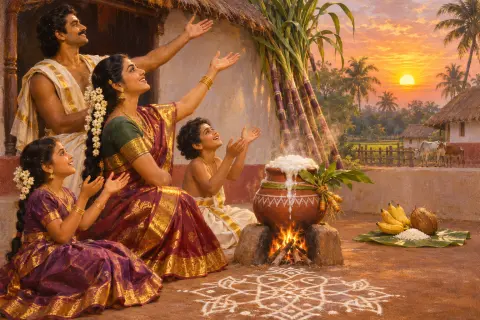
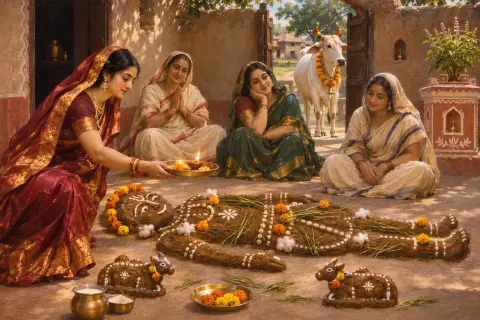
Then Indra came alone, ashamed, and asked forgiveness. Surabhi, the mother of cows, bathed Krishna with her milk, and Indra, at the gods' request, bathed him with heavenly Ganga water carried by his elephant Airavata. They named him Govinda, lord of the cows. Govardhan Puja remembers the day. A Tamil tradition adds that Krishna let Indra keep one day of honour, and that day is Bhogi, the first day of Pongal.
How to recognise
•A crowned king, fair or golden skinned, usually with two arms. His mark is the vajra, the thunderbolt, drawn as a short rod with a grip in the middle and curved prongs at both ends. The Gita (10.28) says that among weapons Krishna is the vajra.
•He rides Airavata, a white elephant. The Bhagavata Purana (8.8.4) says Airavata rose from the churning of the ocean with four white tusks. In Thailand and Cambodia, where Indra is called Phra In, Airavata (Erawan) is often shown with three heads.
•In the Rigveda he rides a golden chariot pulled by two tawny horses (hari), drinks soma before battle, and holds the vajra that Tvashtar made for him. Later he has a heavenly horse, Uchchaihshravas, and a charioteer, Matali.
•The rainbow is his bow. In Hindi and many Indian languages it is still called Indradhanush, Indra's bow.
•Some sculptures cover his body with eyes, for his name Sahasraksha, the thousand eyed. Later retellings explain the eyes as the softened form of Gautama's curse after the Ahalya story; the Valmiki Ramayana tells that curse differently.
•On temple walls he guards the east as one of the eight dikpalas, the guardians of the directions, usually on his elephant.
•In the Puranas, paintings often show him in his court in Amaravati with his queen Shachi beside him and apsaras dancing, a picture of heavenly pleasure that does not last.
Among the Vedas I am the Sama-Veda; I am Vasava among the gods; among the senses I am the mind; and I am intelligence among living beings.
"Among the gods I am Vasava." Vasava, lord of the Vasus, is a name of Indra, and Shankara's commentary reads it so. The chief of the gods is named as a sign of Krishna's glory.
Among weapons I am the thunderbolt; among cows I am the wish-fulfilling cow called Kamadhenu; I am the progenitor, the god of love; among serpents I am Vasuki.
"Among weapons I am the vajra." The thunderbolt is Indra's weapon, the one he used against Vritra.
The knowers of the three Vedas, the drinkers of Soma, purified of all sins, worshipping Me by sacrifices, pray for the way to heaven; they reach the holy world of the Lord of the gods and enjoy in heavn the divine pleasures of the gods.
Those who perform Vedic sacrifices for heaven reach "the holy world of the lord of the gods", surendra-loka, Indra's heaven, and enjoy its pleasures.
They, having enjoyed the vast heaven, enter the world of mortals when their merit is exhausted; thus abiding by the injunctions of the ï1threeï1 (Vedas) and desiring (objects of) desires, they attain to the state of going and returning.
The next verse adds that when their merit runs out, they return to the world of mortals. Indra's heaven is a reward, not freedom, which is how the Gita places it.