
Lakshmana
Rama's loyal younger brother
Lakshmana is Rama's younger brother in the Ramayana, the son of King Dasharatha and Queen Sumitra, and the twin of Shatrughna. He is known for his loyalty: he left his wife Urmila and the palace to follow Rama into fourteen years of exile, guarded Rama and Sita in the forest, and fought beside Rama in Lanka, where he killed Ravana's son Indrajit. He is also known for his quick temper, which Rama often has to calm. His story runs through the whole of the Valmiki Ramayana, and in temples and homes he stands beside Rama and Sita in the Ram Darbar.
Also called: Saumitri (son of Sumitra), Lakshman, Lakhan (in Hindi and Awadhi), Ramanuja (Rama's younger brother), Urmilapati (husband of Urmila), Shesha or Sheshavatara (as the serpent Shesha in later Vaishnava belief), Ilakkuvan (in Kamban's Tamil Ramayana)
Parents: King Dasharatha of Ayodhya and Queen Sumitra
Twin brother: Shatrughna; half-brothers: Rama (son of Kausalya) and Bharata (son of Kaikeyi)
Wife: Urmila, daughter of King Janaka and sister of Sita
Sons: Angada and Chandraketu, who were given kingdoms in the west and the north (Uttara Kanda, sarga 102)
Teachers: Vasishtha, and Vishvamitra on the journey to Mithila
Home: Ayodhya; fourteen years in the forest at Chitrakuta, the Dandaka forest and Panchavati
रामं दशरथं विद्धि मां विद्धि जनकात्मजाम्। अयोध्यामटवीं विद्धि गच्छ तात यथासुखम्॥
rāmaṃ daśarathaṃ viddhi māṃ viddhi janakātmajām, ayodhyām aṭavīṃ viddhi gaccha tāta yathāsukham.
Think of Rama as your father Dasharatha, think of Janaka's daughter as me, and think of the forest as Ayodhya. Go, my son, and be happy.
Stories
Lakshmana's story is told in the Valmiki Ramayana from beginning to end. The chapter and verse numbers below follow the commonly printed southern text, as given on sa.wikisource; the Critical Edition from Baroda numbers some sargas differently and leaves out some verses. In Valmiki he is a loyal, brave and hot-tempered younger brother. Later works give him more: the Adhyatma Ramayana and Tulsidas's Ramcharitmanas treat him as Shesha, the serpent of Vishnu, and folk songs in many languages add stories that Valmiki does not tell, such as the Lakshmana rekha and his wife Urmila sleeping for fourteen years so that he could stay awake.
The brother who would not leave Rama
When King Dasharatha's queens bore four sons, Sumitra had twins, Lakshmana and Shatrughna (Bala Kanda, sarga 18). Valmiki says Lakshmana loved Rama from childhood, like a second life outside Rama's body. Rama could not fall asleep without him, and would not eat food unless Lakshmana was with him. When Rama went hunting, Lakshmana followed him with his bow.
When Kaikeyi's boons sent Rama to the forest, Lakshmana was furious with his father, and Rama had to calm him. Then he begged to go too. 'I will walk ahead of you with my bow,' he said, 'and you will wander through lovely forests with me.' He wanted neither heaven nor immortality without Rama (Ayodhya Kanda, sarga 31). Rama agreed.
When Lakshmana went to say goodbye, his mother Sumitra kissed his head and said the verse given at the top of this page: think of Rama as your father, of Sita as your mother, and of the forest as Ayodhya (Ayodhya Kanda, sarga 40). It is one of the most quoted verses of the Ramayana.
Awake all night by the Ganga
On the first nights of exile the three of them reached Shringaverapura on the Ganga, where Guha, king of the Nishada forest people, welcomed them. Rama and Sita lay down to sleep on a bed of grass under an ingudi tree. Guha offered to keep watch so that Lakshmana could rest. Lakshmana refused: how could he sleep, he said, while the son of Dasharatha slept on the ground (Ayodhya Kanda, sargas 50 and 51). The two men sat up the whole night talking of Ayodhya and of the old king's grief.
Later, at Chitrakuta, Lakshmana saw a great army coming through the forest. It was Bharata. Lakshmana was sure Bharata had come to kill them and wanted to fight him (Ayodhya Kanda, sarga 96). Rama told him that Bharata had never wronged them and was coming out of love. He was right, and Lakshmana was ashamed of his anger.
In the Uttara Kanda Lakshmana says nothing about not sleeping for fourteen years. That story, and the story of Urmila taking his share of sleep in Ayodhya, come from later folk tellings, especially in Telugu, and are told with great love but are not in Valmiki.
Shurpanakha, the golden deer and Sita's words
At Panchavati, Lakshmana built the leaf hut where the three of them lived (Aranya Kanda, sarga 15). There Ravana's sister Shurpanakha came, first to Rama and then to Lakshmana, asking each to marry her. Both laughed at her. When she rushed at Sita to devour her, Rama told Lakshmana to stop her, and Lakshmana drew his sword and cut off her nose and ears (Aranya Kanda, sarga 18). This brought on the war with Ravana.
Later a golden deer appeared, and Lakshmana warned Rama that it was surely the demon Maricha in disguise. Rama went after it anyway and left Lakshmana to guard Sita. When the dying demon cried out in Rama's voice, Sita begged Lakshmana to go. He told her that no one could harm Rama. Then Sita, frantic, said terrible things: that he wanted Rama dead so he could have her, that perhaps Bharata had sent him (Aranya Kanda, sarga 45). Hurt to the heart, Lakshmana called on the forest gods to protect her and left.
Valmiki has no line drawn on the ground. The Lakshmana rekha comes from later retellings and folk tradition; in Tulsidas's Ramcharitmanas it is only mentioned in passing, by Mandodari in Lanka. Today it is one of the best known pictures of the Ramayana, and the phrase is used in Hindi for any limit that must not be crossed.
Sita's anklets and the anger at Kishkindha
When Rama met the vanara Sugriva, Sugriva showed him a bundle of jewels that a woman had dropped from the sky while being carried off. Rama, weeping, asked Lakshmana if he knew them. Lakshmana answered: 'I do not know the armlets, I do not know the earrings. But I know the anklets, because I bowed at her feet every day' (Kishkindha Kanda, sarga 6). People quote these lines as a picture of the respect he had for her.
Rama helped Sugriva win back his kingdom, and they waited through the rains. But when the rains were over Sugriva, now king, was enjoying himself and forgot his promise to search for Sita. Rama sent Lakshmana to Kishkindha, and he went in a fury, twanging his bow so that the whole vanara city shook (Kishkindha Kanda, sargas 31 to 33). Tara, the wise widow of Vali, came out to meet him and calmed him with gentle words, and Sugriva hurried to send his armies out.
Indrajit, and the spear that struck him down
In the war in Lanka Lakshmana was Rama's right hand. His greatest fight was with Ravana's son Indrajit, the magician who had already struck the brothers down twice. With Vibhishana's help, Lakshmana caught him before he could finish a sacrifice that would have made him unbeatable. They fought for a long time. At last Lakshmana set an arrow to the bow and spoke a vow: 'If Rama, son of Dasharatha, is righteous and true to his word and has no equal in courage, then kill this son of Ravana.' He let fly with Indra's weapon, and Indrajit's head fell (Yuddha Kanda, sarga 90).
Soon after, Ravana himself threw a great spear at Lakshmana, and he fell (Yuddha Kanda, sarga 100). Rama broke down. 'In every land one can find a wife,' he said, 'in every land one can find kinsmen. But I see no land where I can find a brother like him' (sarga 101). The vanara physician Sushena sent Hanuman for healing herbs, and Lakshmana was brought back to life.
The last years
The Uttara Kanda gives Lakshmana a hard task. When Rama decided to send Sita away, he ordered Lakshmana to take her across the Ganga and leave her near Valmiki's hermitage. Lakshmana did it, weeping, and told Sita the truth only when they had crossed the river (Uttara Kanda, sargas 45 to 47).
Years later Kala, Time himself, came to Rama in the form of an ascetic with a message from Brahma, and asked to speak alone. Rama promised that anyone who interrupted them would be put to death, and set Lakshmana at the door. Then the sage Durvasa arrived and threatened to curse Rama's whole family if he was not let in at once. To save the family, Lakshmana went in (Uttara Kanda, sargas 103 to 105).
Rama could not bear to kill his brother. On Vasishtha's advice he sent him away instead, saying that for a good man being cast off is the same as death. Lakshmana went straight to the bank of the Sarayu, sat in meditation and stopped his breath, and Indra and the gods carried him up to heaven (Uttara Kanda, sarga 106). Rama followed him into the Sarayu soon after.
How to recognise
- •A young man with two arms, a bow in his hand and a quiver on his back, standing at Rama's right or a little behind him. Painters usually give him a fair or golden skin beside the dark-blue Rama, which makes the two brothers easy to tell apart.
- •In the Ram Darbar picture he stands beside the throne, often holding a bow or the royal umbrella or fly whisk, while Hanuman kneels in front.
- •In forest scenes he wears plain ochre or bark cloth with his hair tied up in matted locks, like Rama, as the Ayodhya Kanda describes when they leave for exile.
- •Shown with a hooded serpent behind or above him in some temple images, because later Vaishnava tradition says he was Shesha (Adishesha), the serpent on whom Vishnu rests. Valmiki does not say this.
- •In Ramlila he is easy to spot as the younger brother in yellow or saffron with a bow, often the one who flares up in anger. In Kathakali he wears the green (pacha) make-up of noble heroes, like Rama.
- •The line drawn on the ground in front of the hut, the Lakshmana rekha, is a popular picture in calendar art and on television. It comes from later retellings, not from Valmiki.
Festivals
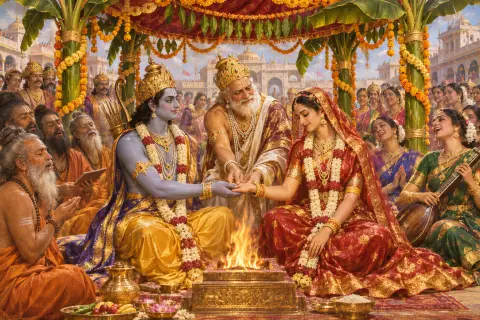 Vivah PanchamiDec 14, 2026He married Sita's sister Urmila in Mithila in the same ceremony as Rama's wedding.
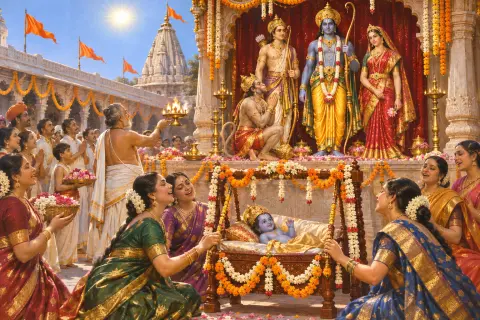 Ram NavamiApr 15, 2027His birth to Sumitra is part of the story told on Rama's birthday, and he is worshipped beside Rama, Sita and Hanuman on Rama's birthday.
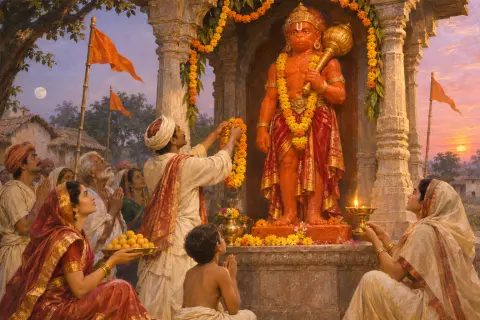 Hanuman JayantiApr 20, 2027The best known story of Hanuman is his flight with the mountain of herbs to save the wounded Lakshmana.
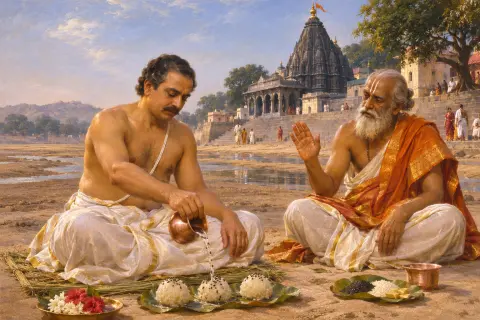 Pitru PakshaSep 15 - Sep 29, 2027A Gaya tradition says he came there with Rama and Sita to offer pinda for their father Dasharatha.
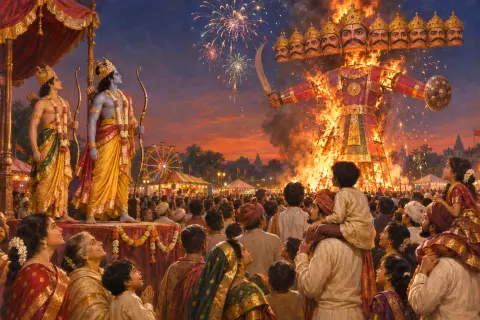 DussehraOct 9, 2027In Ramlila he stands beside Rama through the war, and the actor playing him is on stage when Ravana's effigy burns.
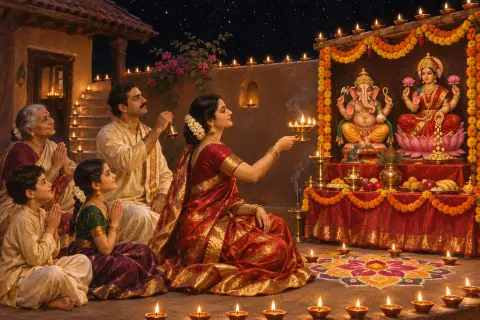 DiwaliOct 29, 2027North India lights lamps for his homecoming to Ayodhya with Rama and Sita.
Paintings
8 paintingsAsk about Lakshmana
Ask Gita Chat about Lakshmana and what their story can teach you.